
AC Not Blowing Cold Air? Here's How to Fix It
Your AC is running but the air coming out feels warm. That's one of the most frustrating things to deal with on a hot summer day in Placer County. Before you panic, know this: most of the common causes are things you can check yourself in under 30 minutes. Here's how to work through them, step by step.
Step 1: Check and Replace Your Air Filter
A clogged air filter is the single most common reason an AC runs but doesn't cool. When the filter gets packed with dust and debris, airflow through the system drops to almost nothing. The evaporator coil can't absorb heat from your home's air, so the system keeps running without actually cooling anything.
Pull the filter out and hold it up to a light. If you can't see light through it, it's time for a new one. Most standard 1-inch filters need replacement every 30 to 90 days. Thicker 4-inch media filters can go 6 to 12 months, but that depends heavily on pets, dust levels, and how much the system runs.
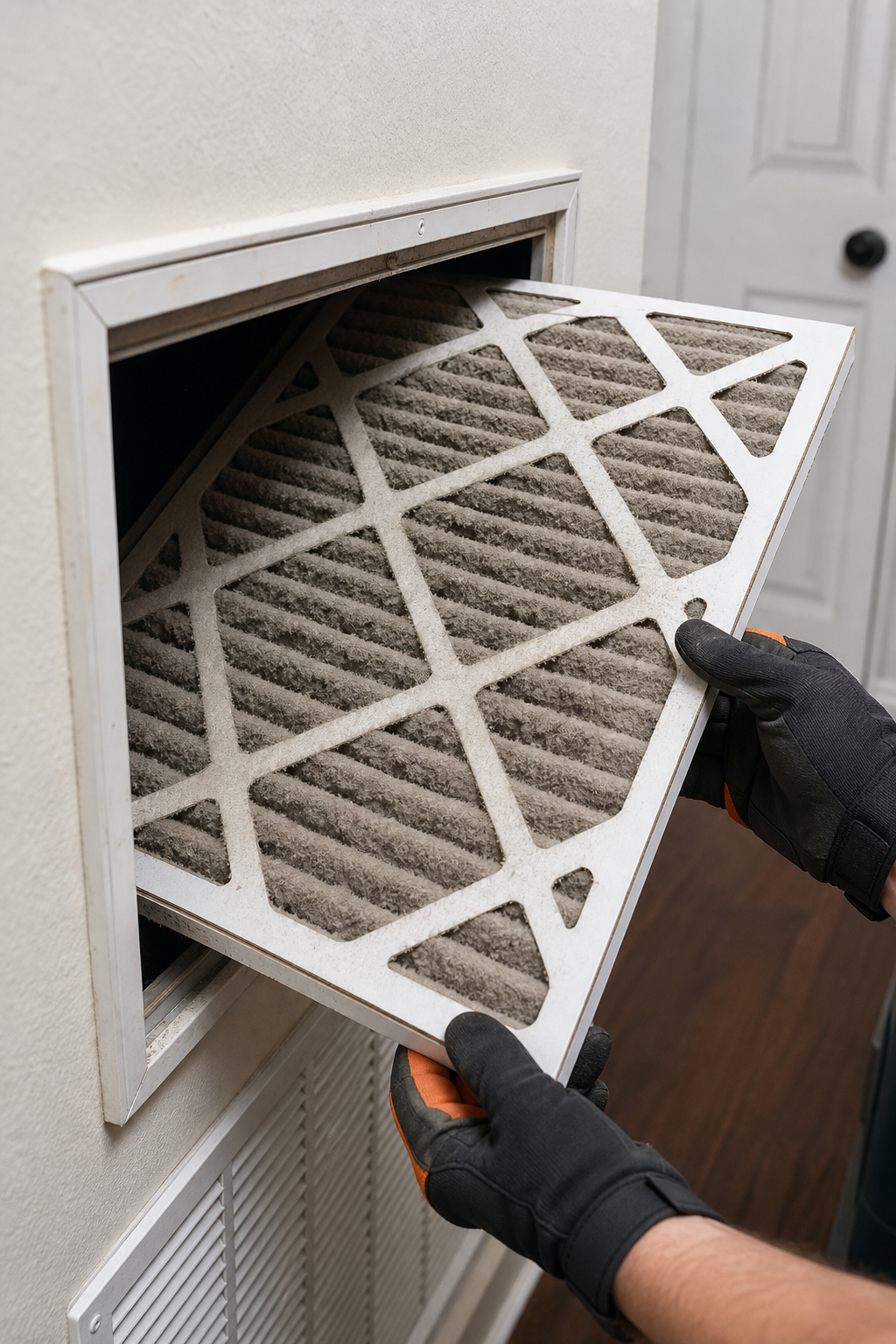
Replacing a dirty filter takes about two minutes. Slide the new filter in with the airflow arrow pointing toward the air handler, not away from it. Run the system for 15 minutes after and check whether the supply vents are now pushing out noticeably cooler air.
If you have pets or live in a dusty area like the foothill communities around Colfax or Auburn, check your filter monthly. A filter that looks fine after 30 days might be packed solid after 60. Set a calendar reminder so it doesn't slip.
Pro Tip:Buy filters in a 6-pack and store them near the air handler. When you see the filter, you remember to check it. That small habit prevents a surprising number of no-cold-air service calls.
Replacing a clogged filter can lower your AC's energy consumption and directly restores cooling performance that restricted airflow was killing.
Step 2: Inspect Your Thermostat Settings
This sounds basic, but thermostat settings cause more service calls than people expect. Two mistakes show up constantly.
First, check that the system is set toCOOL, not HEAT or just FAN. A thermostat accidentally bumped to HEAT will push warm air through your vents all day. Second, confirm the fan is set toAUTO, not ON. When the fan runs continuously on ON mode, it circulates room-temperature air even when the compressor is off between cooling cycles. The air feels warm even though the system is technically working fine.
Set the thermostat to at least 5 degrees below the current room temperature. Give the system 3 to 5 minutes to start a cooling cycle. You should hear the outdoor unit kick on. If you do, stand at a supply vent and feel the air. Cold air means the system is working and your thermostat setting was the fix.
While you're at the thermostat, check the batteries if it's a battery-powered unit. A thermostat with dying batteries can behave erratically, sometimes holding the wrong setting or failing to signal the system to cool at all. Fresh batteries cost almost nothing and rule out a surprising number of issues.
Smart thermostats can also run into software quirks. If you have a programmable or Wi-Fi thermostat, check whether a schedule is overriding your manual setting. Some models revert to a programmed mode after a set time, which can make it seem like the AC stopped responding to your input.
If adjusting the thermostat doesn't trigger the outdoor unit within 5 minutes, move on to the next step. For homeowners in the greater Sacramento region, our Roseville HVAC service page has additional guidance on common cooling problems by system type.
Step 3: Look for a Frozen Evaporator Coil
A frozen evaporator coil is one of the more alarming-looking problems, but it's also one where you can take an immediate helpful step before calling anyone. The evaporator coil sits inside your air handler. Its job is to absorb heat from your home's air as refrigerant passes through it. When airflow is restricted or refrigerant levels drop, the coil gets so cold that moisture on it freezes solid.
Signs of a frozen coil include warm air from the vents, ice visible on the refrigerant lines near the air handler, water dripping or pooling around the indoor unit, and a system that runs constantly without cooling.
The first thing to do is turn the AC off at the thermostat. Switch the fan to ON so it blows room-temperature air over the coil and speeds up the thaw. Depending on how much ice built up, this can take 1 to 24 hours. Do not chip or pry the ice off. You'll damage the coil.
Once the coil has fully thawed, replace the air filter if you haven't already, then restart the system. A frozen coil caused purely by a dirty filter often won't refreeze once airflow is restored. But if it freezes again within a day or two, the underlying cause is likely low refrigerant, and that requires a licensed technician.
Keep a towel near the air handler while the coil thaws. As the ice melts, water drains into the condensate pan and out through the drain line. If the drain line is clogged, that water will overflow the pan and drip onto the floor. You can pour a cup of diluted white vinegar down the drain line access port to clear minor clogs while you wait.
For Lincoln-area homeowners dealing with recurring frozen coils, our Lincoln HVAC repair page covers the most common coil-related issues we see in that area and when they require professional service.
Key Takeaway:A frozen evaporator coil always has an underlying cause. Thawing it is the first step, but finding why it froze is what keeps it from happening again.
Step 4: Check the Condenser Unit Outside
The outdoor condenser unit is where your AC dumps heat pulled from inside your home. If it can't release that heat efficiently, the whole system backs up and stops cooling properly.
Walk outside and look at the condenser. The fan on top should be spinning when the system is running. If it's not, you may have a bad capacitor or fan motor. Those are repairs for a licensed technician.
Next, look at the fins on the sides of the unit. These aluminum fins need clear airflow to dissipate heat. A common issue is grass clippings, leaves, or cottonwood seeds packed against the fins. You can spray the fins gently with a garden hose from the inside out (not outside in) to clear debris. Cut back any shrubs or plants within 2 feet of the unit.
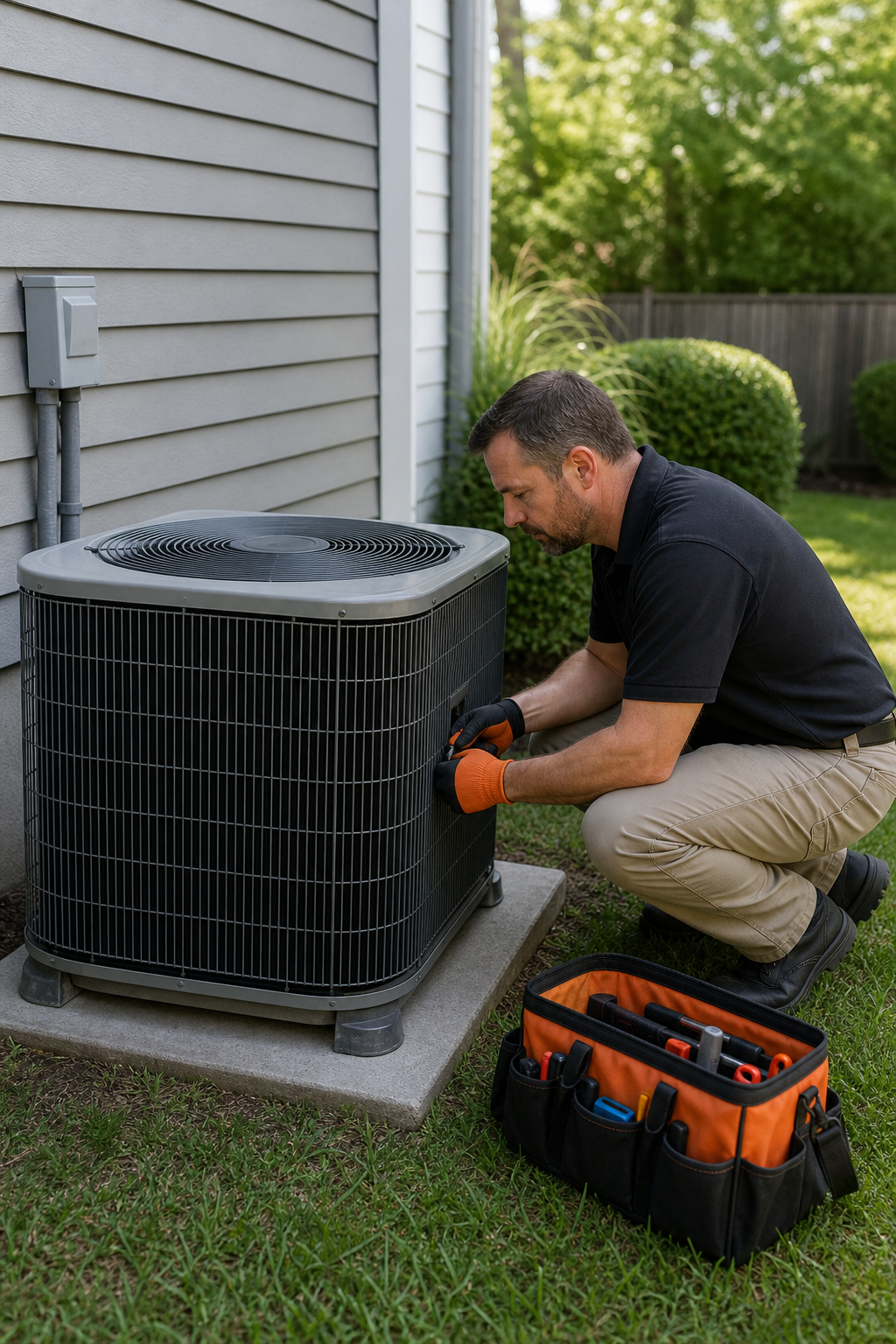
Also check that no one has accidentally covered the unit or stored items against it. A single piece of furniture, a tarp, or even overgrown landscaping blocking the top or sides can push the system into overheating and shutdown. The condenser needs several feet of clear space on all sides.
While you're outside, look at the refrigerant lines running from the condenser into your home. These are the copper pipes wrapped in insulation. If the insulation is cracked, missing, or the lines look frosted, that's a signal worth noting for the next step. Damaged line insulation leads to energy loss and can contribute to freezing problems.
If the fan is spinning, the fins are clean, and airflow is clear but the system still isn't cooling, the problem is most likely inside the refrigerant circuit or the compressor itself. When maintenance tasks like cleaning and clearing don't fix a condenser issue, it's time to call a professional. Home Worx Heating and Cooling offers emergency AC repair across Placer and Nevada County , including same-day diagnosis on condenser faults.
One thing worth knowing: when you're doing routine outdoor maintenance throughout the year, a clean condenser is one of the best investments in system longevity. A well-maintained condenser runs more efficiently and lasts longer before needing replacement.
Step 5: Identify Signs of Low Refrigerant
Refrigerant is the substance that actually moves heat out of your home. It cycles between the indoor evaporator coil and the outdoor condenser in a closed loop. A properly functioning system doesn't consume refrigerant. If the level is low, it means there's a leak somewhere in the system.
You can't check refrigerant levels yourself. That requires a licensed technician with proper gauges and EPA certification. But you can recognize the signs that low refrigerant is the problem.
- The air from your vents is slightly cool but never gets cold, even after running for an hour.
- The outdoor unit runs constantly and the house still doesn't reach the set temperature.
- You notice ice forming on the refrigerant lines or the indoor coil (even after ruling out a dirty filter).
- You hear a hissing or bubbling sound near the indoor unit or the refrigerant lines. That sound can indicate refrigerant escaping through a small leak.
- Your electricity bills have crept up without any obvious explanation, because the system is working harder to compensate for the loss.
Refrigerant leaks don't fix themselves. Simply adding more refrigerant without finding and repairing the leak is a short-term patch. The system will lose charge again, and you'll be back to warm air within weeks or months. A proper repair involves finding the leak, fixing it, and then recharging to the manufacturer's specified pressure.
Most residential systems built after 2010 use R-410A, while older systems used R-22, which is no longer manufactured in the US. If your system is old enough to use R-22, refrigerant is increasingly expensive and hard to source, which often makes replacement a smarter financial decision than repeated recharging.
This is also where the financial side matters. Refrigerant leaks and compressor-related repairs can run into the hundreds or even low thousands of dollars depending on the scope. Home Worx Heating and Cooling has financing available for customers who need repairs but can't cover the full cost upfront, which is a genuine advantage when a repair bill shows up unexpectedly in the middle of a California summer.
Step 6: Know When to Call an HVAC Professional
Some AC problems are safe and straightforward to handle yourself. A dirty filter, a wrong thermostat setting, a clogged condensate drain , those are reasonable DIY fixes. But several situations call for a licensed technician, and trying to go further on your own creates real risk.
Call a professional if:
- The outdoor unit isn't running at all, even after you confirm power to the system.
- The system has ice on the coil but the filter and airflow are both fine.
- You hear hissing, grinding, or banging from inside the unit.
- The circuit breaker for the AC keeps tripping after you reset it.
- You've worked through all the steps above and the air is still warm.
Refrigerant handling, electrical component replacement, compressor diagnosis, and coil repairs all require equipment, certification, and liability coverage that a licensed HVAC contractor carries. Attempting those repairs without the right tools can damage the system further and, in some cases, create safety hazards.
When choosing a contractor, ask a few specific questions. Are they licensed and insured in California? Do they give a clear timeframe for when a technician will arrive? Do they offer any warranty on parts and labor? Transparency on those points matters more than a low estimate that excludes important details. If a contractor can't answer those questions clearly, keep looking.
Home Worx Heating and Cooling is a family-owned HVAC contractor serving Placer and Nevada County with 24/7 emergency service. When your AC stops cooling in the middle of the night or over a weekend, that round-the-clock availability is real relief. Not every local contractor offers it. Some contractors, for example, advertise same-day repairs but don't advertise 24/7 emergency response, which means a late-night call might not get you the same urgency.
If you're weighing repair against replacement, a useful rule of thumb is to multiply your system's age by the estimated repair cost. If the result is high, replacement is often the better long-term investment. A new high-efficiency system also lowers your monthly energy bill, which offsets some of the upfront cost over time. The team at Home Worx can walk you through both options honestly so you're not left guessing.
Frequently Asked Questions
Why is my AC running but not blowing cold air?
The most common causes are a clogged air filter, incorrect thermostat settings, a frozen evaporator coil, or low refrigerant. Start by replacing the filter and checking the thermostat. If the air is still warm after those fixes, look for ice on the indoor unit or listen for unusual sounds near the refrigerant lines, both of which point to a problem that needs a licensed technician.
How do I know if my AC is low on refrigerant?
Signs include air that's slightly cool but never cold, ice on the coil or refrigerant lines, a system that runs nonstop without reaching the set temperature, and a hissing sound near the unit. You can't check the refrigerant charge yourself. Only a licensed HVAC technician with proper gauges can measure it and find any underlying leak before recharging.
Can a dirty air filter cause my AC to stop cooling?
Yes, and it's the most common DIY-fixable cause. A clogged filter blocks airflow through the evaporator coil, which prevents the system from absorbing heat from your home. The compressor keeps running, but the air coming out stays warm. Replacing the filter takes two minutes and often restores cooling immediately. Check the filter monthly if you have pets or live in a dusty environment.
How long does it take for a frozen AC coil to thaw?
Depending on how much ice built up, thawing takes anywhere from 1 to 24 hours. Turn the system to OFF at the thermostat and switch the fan to ON so it blows room-temperature air over the coil. Don't chip the ice off. Once fully thawed, replace the air filter and restart the system. If it freezes again within a day or two, low refrigerant is likely the cause.
When should I call an HVAC technician instead of troubleshooting myself?
Call a technician if the outdoor unit won't run, the circuit breaker keeps tripping, you hear hissing or grinding sounds, or if you've worked through basic checks and the system still blows warm air. Refrigerant handling, electrical repairs, and compressor work require a licensed professional. Attempting those without the right tools risks further damage and potential safety issues.
Is it worth repairing my AC or should I replace it?
A useful starting point is the age-times-repair-cost rule: multiply the system's age by the estimated repair cost. If the total exceeds a certain threshold, replacement is often the smarter move. A new high-efficiency unit cuts monthly energy costs and comes with a manufacturer warranty. An HVAC technician can give you honest numbers on both options so you can make a confident decision rather than guessing.
Conclusion
Work through these steps in order and you'll either fix the problem yourself or know exactly what to tell a technician. If you've checked the filter, thermostat, coil, and outdoor unit and the air is still warm, the next call is to a licensed HVAC contractor. Home Worx Heating and Cooling handles emergency AC repairs across Placer and Nevada County around the clock, with financing available for repairs that come at an inconvenient time. Reach out through the Home Worx services page to get a technician on the way.