
What Does MERV Rating Mean? HVAC Guide
A higher MERV number sounds like a clear upgrade. It isn't always. A MERV 9 filter may capture only about 35% of particles between 1 and 3 microns, while a higher-rated filter can add much finer particle control and also change airflow through your system.
So, what does MERV rating mean? It tells you how well an HVAC filter captures particles of certain sizes. The right choice depends on your air concerns, filter size, system design, and how often you change it.
We pulled the EPA's published MERV particle-capture table and a California field study of pressure drop across 34 residential HVAC systems. EPA data put MERV 8 at 20% capture of 1 to 3 micron particles, MERV 9 at 35%, and MERV 11 at 65%. The California study found average pressure drop of 0.28 inches of water column, nearly triple the 0.10 inches HVAC design protocols assume. A 4-inch MERV 13 filter measured 0.08 inches WC, a thin MERV 7 filter measured 0.20, showing thickness affects airflow more than rating number.
Table of Contents
What Does MERV Rating Mean?
What does MERV rating mean in plain English? MERV stands for Minimum Efficiency Reporting Value . It is a scale used to show how well an air filter traps airborne particles between 0.3 and 10 microns.
A micron is very small. One micron equals one-millionth of a meter. Household dust often contains larger particles, while pet dander, fine dust, mold fragments, and smoke can fall into smaller ranges.
The rating comes from a test method tied to particle size. A filter isn't given one simple “percent clean” score. Instead, it is tested across several particle bands. That detail matters because two filters with nearby MERV numbers may behave differently with fine particles.
For example, lower-rated filters mainly catch larger debris. They help protect the blower and indoor coil from dust. Higher-rated filters trap more small particles, which may help in homes with pets, allergies, asthma concerns, or wildfire smoke.
The Minimum Efficiency Reporting Value definition explains why the number should be read as a test rating, not a promise that every pollutant disappears. MERV measures particles. It does not measure odor removal, gas removal, or carbon monoxide safety.
HEPA is a separate filter classification. A HEPA filter may be used in a portable air cleaner or a specially designed HVAC setup, but a HEPA label is not simply the next number after MERV 20.
We also need to separate filter capture from system performance. A filter can trap more particles and still be a poor fit if it restricts the air your furnace or heat pump needs. Home Worx Heating and Cooling can check the filter cabinet, system type, and airflow before you move to a much higher rating.
Key Takeaway:MERV tells you how well a filter captures tested particle sizes. It does not tell you whether that filter fits your HVAC system.
The MERV Rating Scale: Comparing Filters from MERV 1 to MERV 20
The MERV scale runs from 1 through 20, but most homes use a much smaller part of it. MERV 1 to 4 filters focus on larger dust and debris. MERV 5 to 7 gives more capture for common residential use. MERV 8 to 11 is a common range for homes with pets or mild allergy concerns.
MERV 13 to 16 targets much finer particles. These ratings may suit homes with serious allergy concerns or smoke exposure when the HVAC system can handle them. MERV 17 to 20 is usually associated with specialized filtration rather than a standard one-inch home filter.
MERV range | Typical particle control | Common fit | Decision point |
1 to 4 | Larger dust and debris | Basic protection | Useful when airflow needs to stay very open |
5 to 7 | More household dust and pollen | Standard homes and light commercial use | A modest step above basic panel filters |
8 | At least 70% of particles in the 3 to 10 micron range in the cited test data | Many standard home systems | A sensible baseline for ordinary dust |
11 | At least 65% of particles in the 1 to 3 micron range in the cited test data | Pets, fine dust, and mild allergies | Often a useful step up from MERV 8 |
13 to 16 | Much stronger fine-particle capture | Smoke or serious allergy concerns | Confirm airflow before installation |
17 to 20 | Specialized high-efficiency filtration | Selected commercial or medical settings | Not a normal upgrade for every home system |
The cited comparison data puts MERV 8 at a minimum of 20% capture for 1 to 3 micron particles, while MERV 11 reaches at least 65% in that band. That is why the change from MERV 8 to MERV 11 can matter more to a pet owner than the number alone suggests.
Construction also changes with the rating. Pleated electrostatic media appear often in the higher ranges because the folded surface gives the filter more area. A flat panel filter may have less resistance, but it usually captures less fine material.
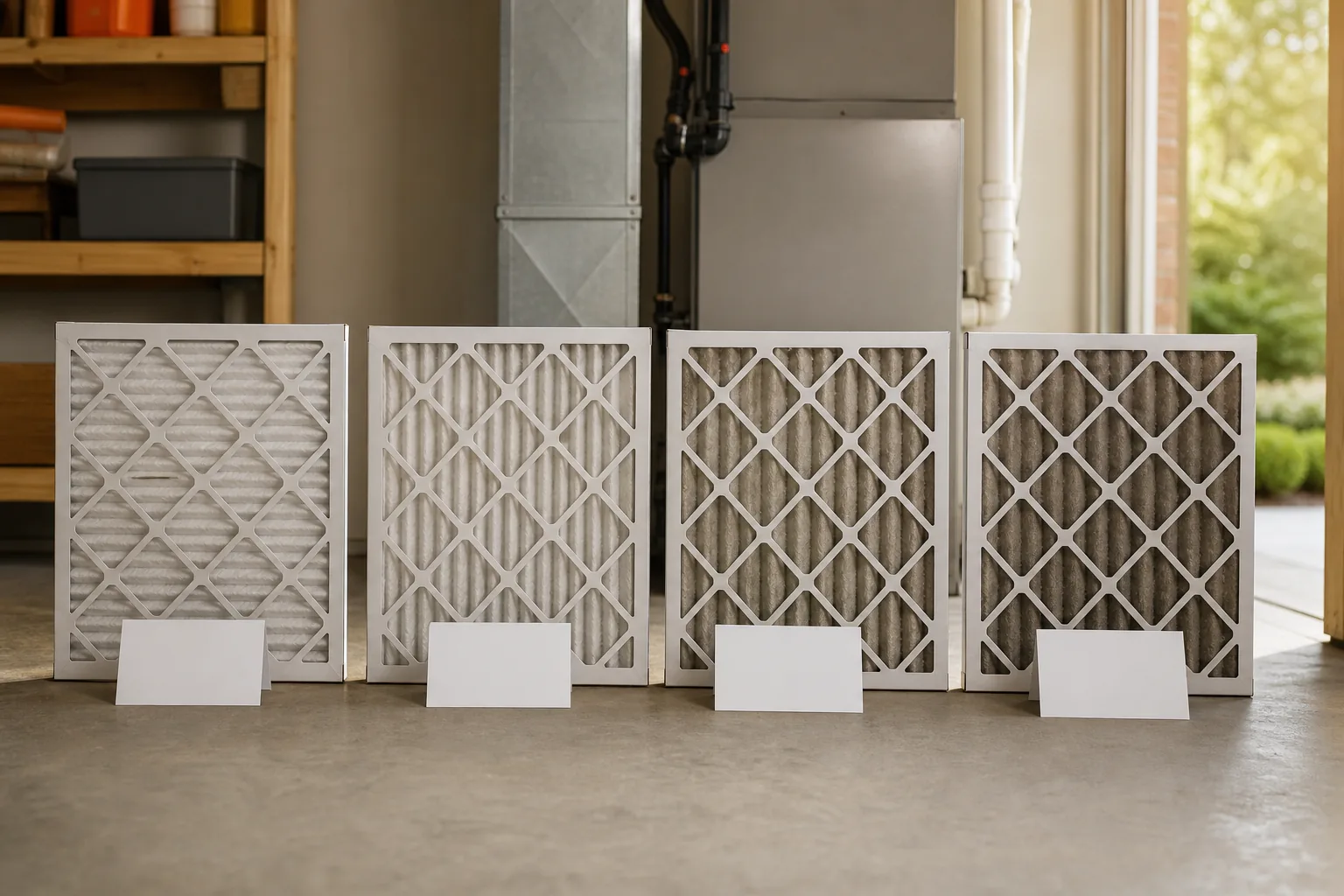
One caution is worth keeping in view. A rating chart cannot replace an airflow check.
For a related HVAC efficiency measure, see our explanation of what SEER rating means . SEER describes cooling efficiency. MERV describes particle capture. They answer different questions.
How MERV Ratings Affect Airflow, Energy Use, and HVAC Performance
What does MERV rating mean for airflow? A higher rating often uses denser media or more filter material. That can increase resistance as air passes through the filter, especially when the filter gets dirty.
Your blower has to move air through the return grille, filter, coil, ducts, and supply registers. If the filter blocks too much air, the system may run longer to reach the thermostat setting. Cooling performance can suffer when the indoor coil does not receive the air it needs.
Heat pumps need steady airflow during both heating and cooling. A restricted filter can make a heat pump work harder. A furnace may also run hotter than intended if the return side cannot deliver enough air.
The effect depends on more than the MERV number. Filter thickness matters. A four-inch filter may provide more media area than a one-inch filter with the same rating. Filter size matters too. A larger surface can spread the air across more material.
Air leaks around the frame create another problem. If the filter does not fit snugly, air can slip around it. The system then loses the benefit of the filter rating while dust reaches the equipment.
Energy use is hard to predict from MERV alone. The right answer depends on blower speed, duct design, filter condition, run time, and system controls. Do not assume MERV 13 will raise your bill, but do not assume it cannot affect performance either.
Check the filter after installation. Listen for new whistling at the return grille. Watch for weak airflow at supply vents. If the system starts short cycling or struggles to hold the set temperature, have a technician test it rather than moving back and forth between filter ratings.
Pro Tip:Write the filter size and installation date on a small note near the return grille. A correct rating still fails when the filter stays in place too long.
Choosing a MERV Filter for Homes and Businesses in Auburn, Colfax, and Rocklin
For homeowners asking what MERV rating means in a Northern California home, start with the problem you want to solve. Dry summers in Auburn and Colfax can bring dust into the home. Cold winter weather means the furnace or heat pump may run for long periods. That makes filter condition as important as the printed number.
MERV 8 is often a reasonable starting point for a home without pets or major allergy concerns. MERV 11 may make more sense when a household has shedding pets, fine dust, or mild allergies. MERV 13 can be worth discussing when smoke or asthma concerns are part of the picture.
Rocklin homes may face long cooling periods during hot weather. A filter that looks clean at the face can still load with fine dust. Check it on a regular schedule and replace it sooner if it looks gray, the home has pets, or the system runs often.
Businesses need a slightly different review. A small office in Lincoln may have a different air volume and filter cabinet than a shop in Colfax. Occupancy changes the particle load. So does the building's outdoor air setting.
In Roseville, wildfire smoke can be a seasonal concern. MERV 13 may help capture fine particles when the equipment can support it, but the system should be checked before making the change. Portable air cleaners may also have a role when central HVAC filtration alone cannot meet the need.
Home Worx Heating and Cooling works with homeowners, small business owners, and property managers across the area. We can match the filter choice to the equipment instead of treating one rating as right for every building.
Before a filter visit, take a photo of the old filter label. Note its length, width, and thickness. Also write down any changes in sound, airflow, or comfort. Those details help a technician see whether the concern is the filter or another part of the system.
If allergies are the main concern, our guide to whether an air purifier helps with allergies explains where portable filtration can fit alongside HVAC service.
Common MERV Filter Mistakes in Roseville, Grass Valley, Penn Valley, and Lincoln
Many filter problems come from a simple mismatch. A homeowner in Grass Valley may buy the highest MERV filter on the shelf, then find weak airflow. A homeowner in Penn Valley may install a lower-cost filter that does not sit tightly in the cabinet. In both cases, the printed number is only part of the answer.
Choosing the highest number by default
A high rating is not automatically better for every blower and duct system. Ask whether the equipment was designed for that filter. If the answer is unclear, have airflow and static pressure checked before moving up.
Using the wrong size
Measure the filter slot when possible. Do not trust a bent old filter as your only guide. A filter that bows or leaves gaps lets air bypass the media.
Forgetting the arrow
The arrow normally points in the direction of airflow, toward the furnace or air handler. Installing it backward can reduce the filter's intended performance and may stress the frame.
Waiting until the filter is packed with dust
A dirty MERV 8 can restrict more air than a fresh MERV 13. Homes with pets, construction dust, or long heating and cooling cycles need more frequent checks. The correct replacement schedule depends on the filter thickness and the home.
Expecting MERV to remove odors
MERV ratings describe particle capture. They do not promise removal of cooking smells, pet odor, or volatile gases. Odor control may need a different type of media or a separate air-cleaning device.
Ignoring the equipment
If the system has weak airflow, unusual noise, icing, or repeated shutdowns, changing the filter may not solve the cause. A blocked coil, damaged duct, or blower issue can look like a filter problem.
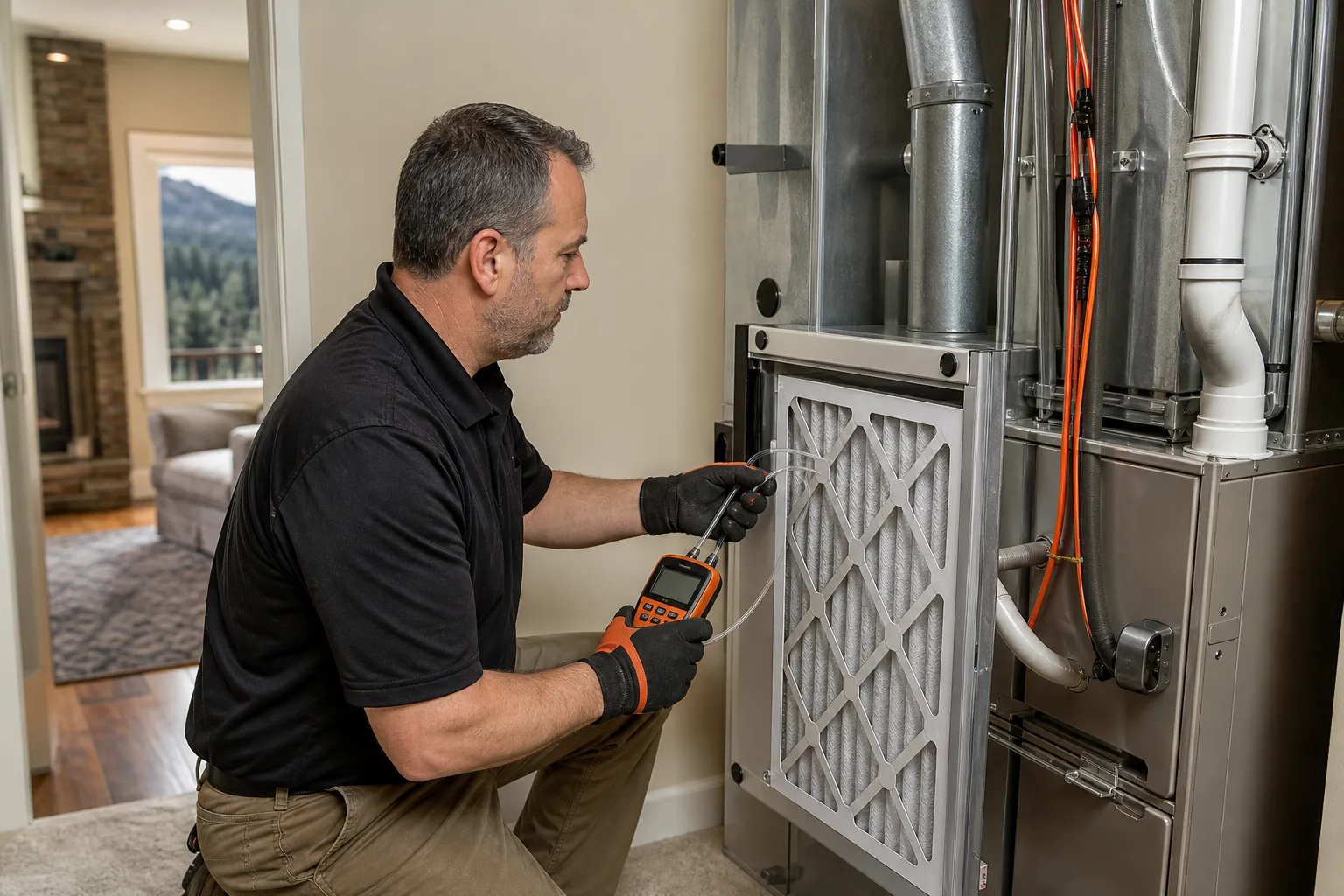
Home Worx Heating and Cooling can help homeowners in Roseville, Grass Valley, Penn Valley, and Lincoln review these issues. We look at the filter slot and the equipment together. That matters more than choosing a number in isolation.
Key Takeaway:Pick the highest MERV rating your system can support while keeping airflow steady, then replace the filter on time.
FAQ: MERV Ratings and HVAC Filters
What does MERV rating mean on an air filter?
MERV rating shows how well an air filter captures particles across tested size ranges. A higher number usually means stronger capture of smaller particles, but it may also add airflow resistance. The rating does not measure odor removal, gas removal, or whether the filter fits your HVAC system.
What is the best MERV rating for a home?
MERV 8 is often enough for ordinary dust in a home without pets or allergy concerns. MERV 11 may suit homes with pets or mild allergies. MERV 13 can help with fine particles such as smoke when the HVAC system supports it. A local HVAC check is wise before choosing a much higher rating.
Is MERV 11 better than MERV 8?
MERV 11 captures more fine particles than MERV 8 in the cited test data. Both can fit many standard home systems, but the right choice depends on equipment design and filter size. Choose MERV 11 when pets, fine dust, or allergies matter, then watch airflow after installation.
Can a high MERV filter damage an HVAC system?
A high MERV filter can cause problems if it restricts airflow beyond what the system can handle. The risk depends on the filter thickness, cabinet, blower, ductwork, and system controls. Signs include weak airflow, unusual noise, long run times, or poor temperature control. Ask a technician to test the system.
How often should I change a MERV filter?
Change a MERV filter when it is loaded with dust or based on the schedule recommended for your system. Pets, smoke, heavy use, and home projects can shorten the interval. The filter's thickness also matters. Our guide to how often to change a furnace filter covers those factors.
Conclusion
MERV is a particle-capture rating, not a simple score for overall air quality. For many homes, MERV 8 or 11 is a sensible starting point, while MERV 13 deserves an airflow check before use. If you're unsure what fits your system in Auburn, Colfax, Rocklin, Roseville, Grass Valley, Penn Valley, or Lincoln, contact Home Worx Heating and Cooling for a local filter and HVAC assessment.