
Air Conditioner Not Cooling? Here's How to Fix It
Your AC is running, the fan is spinning, but the house feels like an oven. It's one of the most frustrating problems a homeowner can face, especially during a hot Sierra-foothill summer. Most cooling failures come down to a handful of fixable causes , and this guide walks you through each one, starting with the simplest checks and moving toward the problems that need a professional.
Step 1: Check Your Thermostat Settings and Power Supply
The goal here is to rule out the simplest possible causes before touching anything else. An AC that won't cool is sometimes an AC that was never asked to cool in the first place.
Start at the thermostat. Make sure it's set toCool, not Fan Only. Fan Only circulates air without activating the compressor, so you'll feel airflow but no cold air. Set the temperature at least 5 degrees below the current room temperature so the system actually calls for cooling. If you have a programmable thermostat, check whether a scheduled program is overriding your manual setting , most have aHoldbutton that locks your set point.
Check the batteries if your thermostat has them. A weak battery can cause erratic behavior or no response at all. Some thermostats pull power directly from the furnace control board , if yours goes blank when removed from the base, that's how it's wired and batteries aren't the issue.
Next, go to your breaker panel. A tripped AC breaker sits in the middle position , not fully on, not fully off. Reset it by pushing it firmly to Off, then back to On. If it trips again immediately, stop. A breaker that keeps tripping signals an electrical fault, and you should call a technician rather than keep resetting it.
Also check the outdoor disconnect box , that gray box mounted on the wall near your condenser. It should be in the On position with fuses intact. Pull out the fuse block and inspect both fuses. A blown fuse is inexpensive to replace and is one of the few fixes that's genuinely DIY-safe. Different units call for different amperage ratings, so match the fuse to your system's spec label before swapping.
Go outside and confirm the outdoor condenser is actually running. The indoor air handler can blow air regardless of whether the outdoor unit is on. If you hear the indoor fan but feel no cooling, walk outside and listen for the compressor hum and watch for the fan spinning. No activity outside usually points to a power, fuse, or capacitor issue , covered in Step 6.
By now you should know whether the system is receiving power and whether the thermostat is asking it to cool.
Step 2: Inspect and Replace a Dirty Air Filter
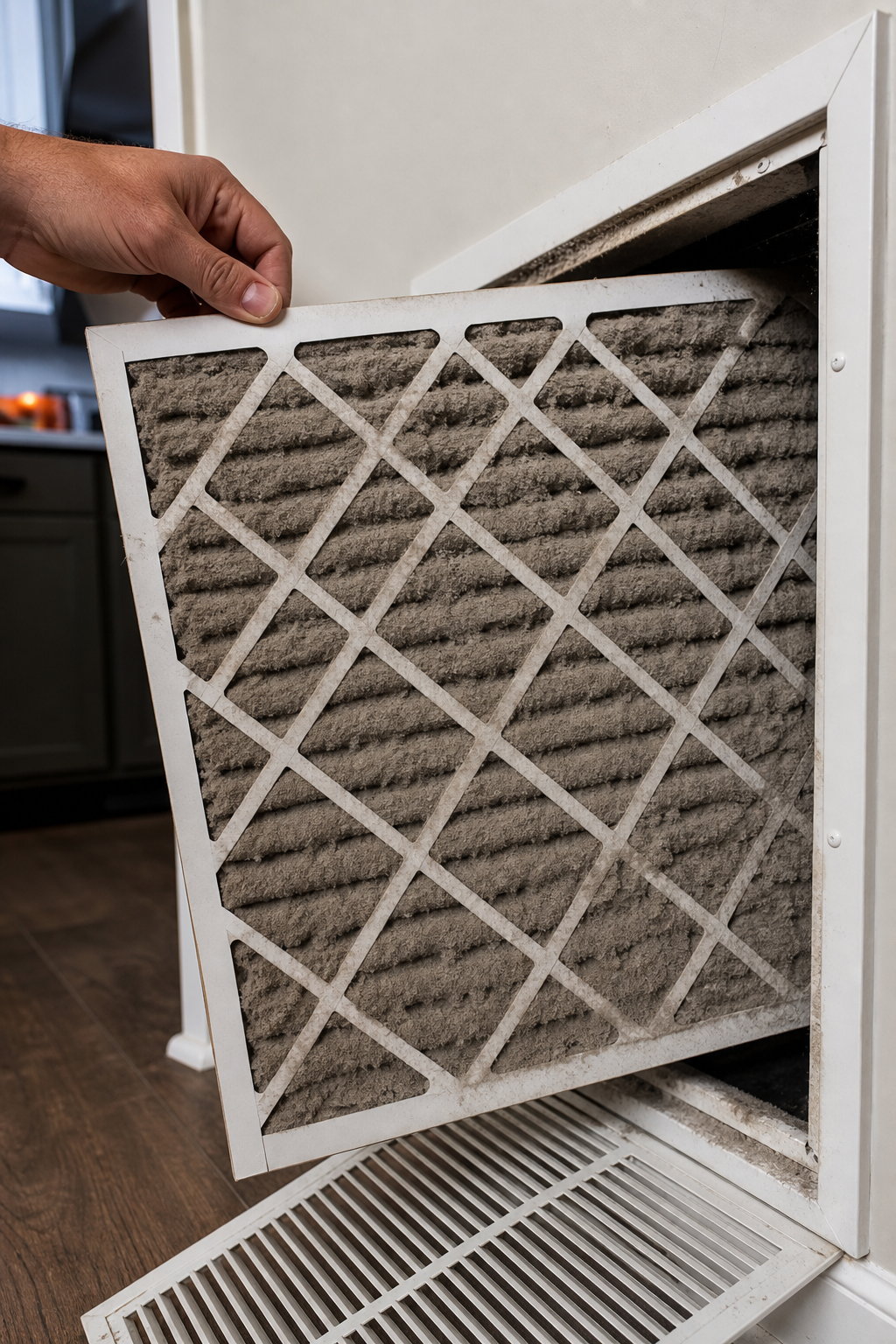
A dirty air filter is one of the most common reasons an air conditioner stops cooling well. When the filter gets packed with dust, airflow drops. Less air moving across the evaporator coil means less heat gets removed from your home. Push it far enough and the coil freezes over entirely , which shuts the system down or causes it to blow warm, wet air.
Find your filter. Most systems have a return air grille in the hallway ceiling or wall, and the filter slides in right behind it. Some systems have the filter at the air handler itself. Slide it out and hold it up to the light. If you can't see light through it, it needs to go.
Filters are rated by MERV score. A MERV 8 to 11 filter catches enough dust without strangling airflow in most residential systems. High-efficiency pleated filters , MERV 13 and above , can actually become so restrictive that they reduce cooling performance almost as much as a dirty filter. If you've been running a very thick, high-MERV filter, try dropping to a mid-range option and see if airflow improves.
Replace the filter and note the airflow arrow on the frame , it should point toward the air handler, not away from it. Running a filter backward can collapse it and pull debris into the blower.
Pro Tip:In the Colfax and Auburn area, wildfire smoke season adds a lot of fine particulate to the air. During smoke events, check your filter every two to three weeks instead of monthly , it can clog much faster than normal and quietly kill your system's cooling capacity.
Change filters every 1 to 3 months as a baseline. If you have pets, kids, or the house sits near pine trees that shed pollen and needles, lean toward every 4 to 6 weeks. A clean filter also protects the evaporator coil from dust buildup , which means less frequent deep cleaning later.
After installing a fresh filter, give the system 20 to 30 minutes to run. If the coil had started to ice up, it needs time to thaw before airflow fully recovers. You should feel noticeably colder air from the vents once the system is running freely again.
By now you should have confirmed whether restricted airflow was the cause , and replaced the filter if needed.
Step 3: Clean the Condenser Unit and Clear Debris
The outdoor condenser unit pulls heat out of your home and dumps it into the outside air. If the coil is clogged with dirt, or debris is blocking airflow around the unit, that heat transfer breaks down , and your house stays warm no matter how hard the system runs.
Cut power at the outdoor disconnect before touching anything. Then take a walk around the unit. You're looking for overgrown shrubs, grass clippings, fallen leaves, and anything else within two feet of the cabinet. Trim vegetation back at least 2 feet on all sides and 6 to 8 feet above the unit so hot discharge air can rise freely. Recycled heat drawn back into the unit is a surprisingly common cause of poor cooling performance.
In Placer County, pine needles and spider webs are the two most common culprits. They pack into the condenser fins and shroud with remarkable speed. Remove the top grille or shroud (usually 4 to 6 screws) and look at the coil surface from the inside. The fins are thin aluminum strips , you should be able to see light through them. If they look matted, it's time to clean.
Use a garden hose on a low-pressure shower setting, spraying from the inside outward to push debris out rather than deeper in. Work downward along the fins, not across them. For heavier buildup, a foaming coil cleaner lets the product dwell on the surface long enough to break down oily grime before you rinse. Our detailed guide on how to clean air conditioner coils covers all 10 methods with safety steps for each.
While you're here, check the base of the unit for standing water and clear the small drainage holes if they're blocked with mud or debris.
After reassembling, wait 30 to 60 minutes before restoring power so everything can dry. A clean condenser can drop your system's energy use noticeably because it no longer has to work as hard to reject heat.
Also inspect the suction line , the larger, insulated copper pipe running into the unit. It should feel icy cold and be sweating condensation on the outside. If it's warm or dry, that's a refrigerant signal worth noting before the next step.
Step 4: Look for Signs of Low Refrigerant or a Refrigerant Leak
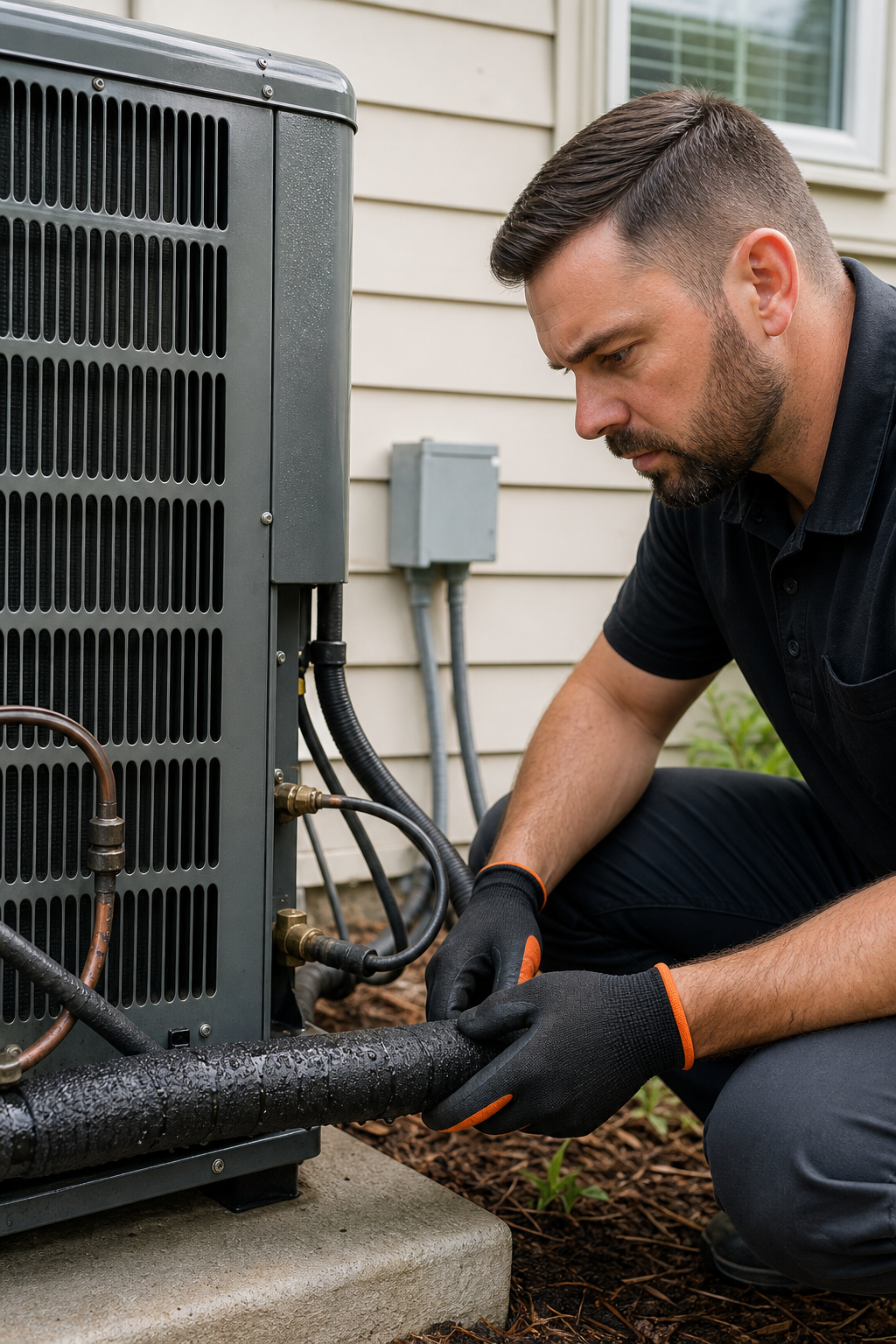
Refrigerant is the substance that actually moves heat. Without the right charge, your system can run all day and barely drop the temperature inside. Low refrigerant almost always means a leak , the system is sealed, so it doesn't "use up" refrigerant the way a car uses gas.
The quickest field check a homeowner can do is feel the suction line. That's the thicker, insulated copper pipe entering the outdoor unit. With the system running for at least 15 minutes, press two fingers against it. It should be icy cold and wet with condensation. If it feels warm, room temperature, or completely dry, the refrigerant charge is likely low.
Other signs of low refrigerant include the indoor evaporator coil freezing over, the system blowing air that's cool but not cold, and longer run times to reach the set temperature. Refrigerant cycles between liquid and gas states to absorb and release heat , when the charge drops, that cycle weakens and the system loses its ability to pull heat from indoor air effectively.
You cannot legally or safely add refrigerant yourself. Handling refrigerant requires EPA Section 608 certification, and the wrong charge , too much or too little , damages the compressor. A technician will use gauges to measure the actual system pressure and compare it against the manufacturer's spec for current conditions.
If there's a leak, the tech will typically add UV dye or an electronic leak detector to find the source. Common leak points include the Schrader valves, evaporator coil connections, and the service ports. A pinhole in the evaporator coil is the most expensive repair because it requires coil replacement.
This is one of the issues where calling a pro early saves you money. Running a low-charge system stresses the compressor , and compressor replacement costs far more than a refrigerant leak repair. The team at Home Worx Heating and Cooling's HVAC services handles refrigerant diagnostics and leak repair for homeowners across Placer and Nevada County.
Key Takeaway:If your suction line isn't cold and wet after 15 minutes of runtime, stop running the system and call a licensed technician , continuing to run a low-charge AC accelerates compressor wear.
Step 5: Check Vents, Ductwork, and Heat Gain Sources
Your system can be working perfectly and still fail to cool the house if the cold air never makes it to the rooms that need it. Duct leaks and heat gain are easy to overlook because they're invisible.
Walk through the house and check every supply vent. They should all be open and unobstructed. Furniture pushed against a vent, closed dampers, or a vent cover accidentally flipped shut can starve a room of airflow without triggering any error on the system itself.
Then think about ductwork. Most homes have ducts running through unconditioned spaces , attics and crawlspaces. In summer, an attic in Colfax or Auburn can hit 140°F or hotter. A disconnected or poorly sealed duct in that space dumps cold air directly into the attic instead of the house. A full duct separation in an attic means all the cold air blows into the ceiling cavity while the house bakes below. Reconnecting and sealing it solves the problem immediately.
You can do a rough duct check yourself. With the system running, feel along accessible duct runs for air escaping at joints. Look for disconnected sections, torn flex duct, or pulled-apart connections. Seal any gaps you find with metal foil tape or mastic sealant. Standard gray cloth duct tape actually degrades quickly in attic heat , foil tape is the right product.
Heat gain sources matter just as much. Open windows, single-pane glass, a west-facing sunroom without shading, or a kitchen running the oven during peak afternoon heat can overwhelm a correctly sized system. If your windows are old or poorly sealed, improving the building envelope helps your AC keep up. Quality window insulation significantly reduces the cooling load your system has to handle , the principle is the same as insulating any air gap in the building shell.
Also check whether doors to unconditioned spaces (garages, storage rooms) are sealing properly. A gap under a garage door on a hot afternoon can dump enough heat to raise your set point by several degrees.
Step 6: Identify Compressor Problems and Electrical Faults
If the outdoor unit runs but still doesn't cool, or the fan spins while the compressor is silent, you're likely looking at an electrical or mechanical fault that needs a technician. This step is about identifying the symptom clearly so you can describe it accurately when you call for help.
The compressor is the heart of the system. When it's running, you'll hear a steady, low rumble from the outdoor unit , different from the higher-pitched fan motor. If you hear the fan but no compressor sound, press your hand gently against the unit cabinet. The compressor creates a distinct vibration. No vibration with the fan running usually points to a failed capacitor, a bad contactor, or a locked-up compressor.
The capacitor is a common failure point. It gives the compressor and fan motor the starting jolt they need. A swollen or leaking capacitor , you can sometimes see a bulging top on the cylinder , can't deliver that jolt, so the motor won't start. Capacitor replacement is a repair many HVAC techs can complete in under an hour.
The contactor is a relay that closes the circuit to your compressor and fan on a call for cooling. Burnt contacts or a failed coil inside the contactor mean the outdoor unit never gets the signal to run. Both the capacitor and contactor are inside the electrical access panel on the side of the condenser , high voltage lives there even with the disconnect pulled, so don't open it unless you're trained.
The compressor is the component most vulnerable to damage from running under abnormal conditions , low refrigerant, wrong voltage, or repeated hard starts. A locked-up compressor that won't turn can sometimes be freed by giving the fan a gentle spin with a long stick through the grates while the unit is trying to start, but this is a temporary diagnostic measure, not a fix.
Buzzing, humming, or rattling from the outdoor unit are not harmless background noise. Buzzing often signals a failing capacitor or loose wiring. Rattling usually means something is physically loose inside , a fan blade, motor mount, or debris that got in. High-pitched squealing points to a blower motor or fan belt problem. All three of these warrant turning the unit off and calling a professional rather than letting the system run.
Step 7: Address High Humidity, Utility Cycling, and Seasonal Maintenance
Sometimes the system is working correctly but the house still feels uncomfortable. Two overlooked causes , high indoor humidity and utility demand cycling , are worth checking before you assume something is broken.
Air conditioners do two jobs: they cool air and they remove moisture. When indoor humidity is very high, the system spends much of its capacity on dehumidification rather than temperature drop. You might see the thermostat hit its set point, but the air still feels heavy and warm because moisture hasn't been removed. A whole-home dehumidifier can take that load off the AC and dramatically improve comfort without requiring the system to work harder.
Utility demand cycling is something many homeowners in California don't know about. PG&E and other utilities sometimes install a cycling switch (also called a demand response switch) on outdoor AC units. During peak grid demand , typically hot afternoons , this switch can interrupt the compressor for 15 minutes out of every 30. The system appears to be running, the fan moves air, but the compressor is off. If your AC stops cooling reliably between 3 p.m. and 7 p.m. on hot days but works fine in the morning, check whether your unit has one of these switches installed.
Seasonal maintenance prevents most of the problems covered in this guide from developing in the first place. A spring service visit , before cooling season peaks , should include coil cleaning on both the condenser and evaporator, refrigerant pressure check, electrical connection inspection, capacitor and contactor testing, and a condensate drain flush. Fall service focuses on the heating side but is a good time to clear vegetation from around the condenser and note any wear on electrical components before next summer.
Here in Placer and Nevada County, pollen and pine debris are heavy in spring, and wildfire smoke in late summer can pack filters and coils faster than normal. Twice-a-year maintenance isn't overkill , it's the standard cadence that keeps systems running through a full cooling season without surprises.
If you've worked through all seven steps and the house still isn't reaching temperature, that's the point to bring in a licensed technician. The best emergency AC repair options in Placer and Nevada County are worth bookmarking for exactly this scenario. Home Worx Heating and Cooling offers 24/7 service for homeowners across the region , from Auburn and Colfax to Roseville and Grass Valley , with same-day and next-day diagnostics during peak season.
Buzzing, humming, rattling, banging, and high-pitched squeals are all signs of electrical or mechanical faults — such as a failing capacitor, loose wiring, a loose fan blade, or a problem with the blower motor — that should be diagnosed with the unit off and evaluated by a professional rather than left to run while you wait for the weekend.
Frequently Asked Questions
Why is my AC running but not cooling the house?
The most common reasons are a dirty air filter, a clogged condenser coil, low refrigerant, or the outdoor unit not running at all. Start by checking whether the outdoor condenser is on and the filter is clean. If both look fine, the issue is likely refrigerant, a capacitor fault, or a compressor problem , all of which need a licensed technician to diagnose properly.
How do I know if my AC is low on refrigerant?
Touch the large insulated copper pipe (the suction line) on your outdoor unit after the system has run for 15 minutes. It should be icy cold and sweating condensation. If it's warm or dry, refrigerant is likely low. Other signs include the indoor coil icing over, weak cooling despite a clean filter, and the system running constantly without reaching the set temperature.
Can a dirty air filter cause the AC to stop cooling?
Yes. A clogged filter restricts airflow across the evaporator coil, reducing the system's ability to absorb heat from indoor air. Severe restriction can freeze the coil solid, which stops cooling entirely. Replacing the filter and letting the ice thaw , usually 30 minutes to an hour with the system off , often restores normal operation without any other repair needed.
Why does my AC cool well in the morning but not in the afternoon?
Afternoon heat load is heavier , the sun hits the west side of your home, attics absorb heat all day, and outdoor temperatures peak. If the system barely keeps up, it may be undersized, have a dirty condenser coil, or be affected by utility demand cycling, which PG&E uses to cut compressor power during peak grid hours. Check for a demand-response switch on your outdoor unit.
When should I call a technician instead of troubleshooting myself?
Call a technician if you hear buzzing, rattling, or high-pitched squealing from the unit , these signal electrical faults or loose components that can cause further damage if the system keeps running. Also call if the breaker trips repeatedly, if you suspect low refrigerant, or if the compressor doesn't start. Thermostat checks and filter replacements are safe DIY steps; everything involving refrigerant or electrical components is not.
How often should I service my AC to prevent cooling problems?
Once a year at minimum, ideally in spring before cooling season. In Placer and Nevada County, where pine pollen, wildfire smoke, and summer heat put extra stress on systems, twice-yearly service is a usable choice. Annual maintenance catches failing capacitors, low refrigerant, and coil buildup before they turn into breakdowns during a heat wave.
Ready to Get Your Home Cool Again?
Work through the steps above in order , thermostat and power, then filter, then condenser, then refrigerant, then ducts, then electrical. Most cooling failures come down to one of these causes, and several you can fix yourself in under an hour. If you've gone through the list and the house still isn't cool, that's the time to call in a pro. Home Worx Heating and Cooling serves Placer and Nevada County homeowners with same-day diagnostics and 24/7 emergency service , contact us to get a technician out fast.