
Best Heat Pump Water Heater vs Tankless Options
- Bryn Fortmuller
- Jul 30
- 15 min read
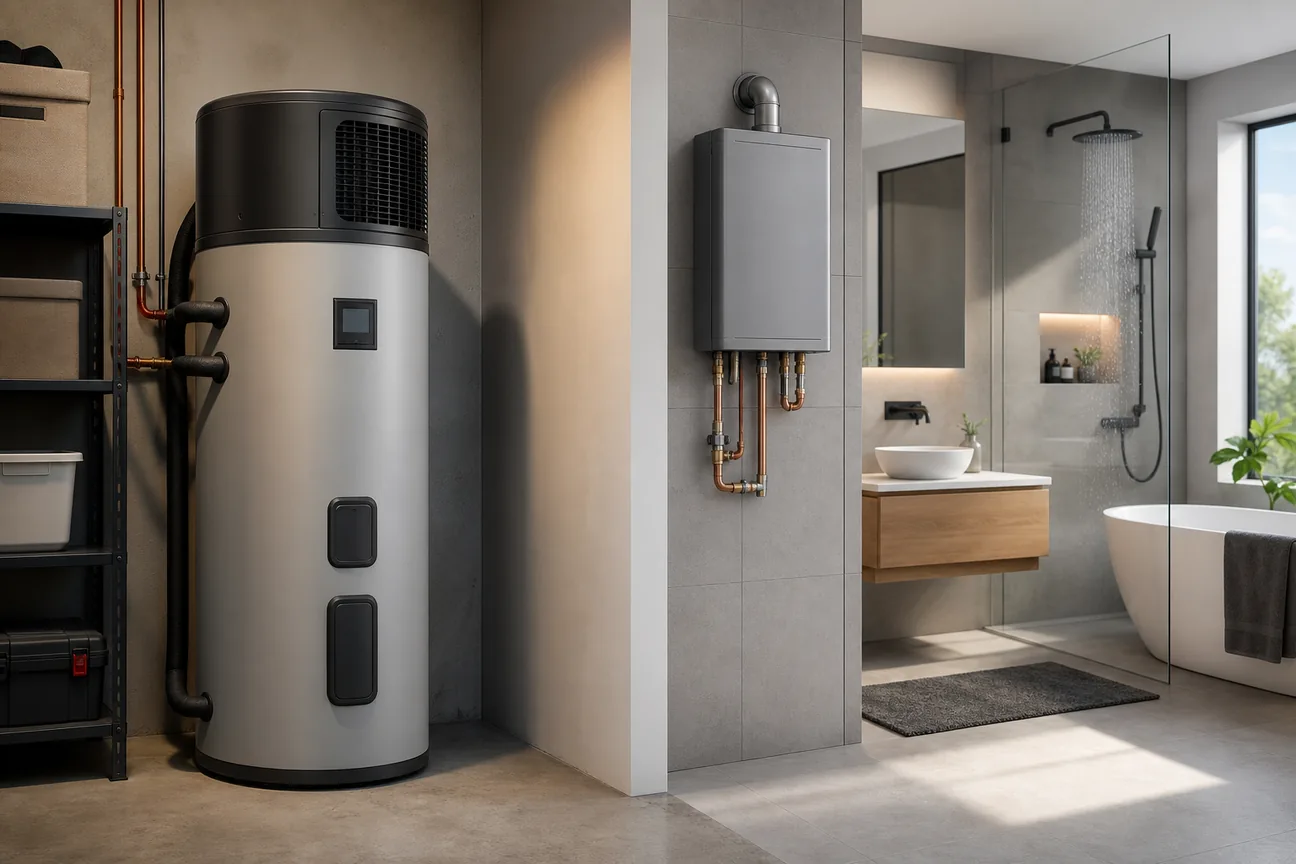
Choosing between a heat pump water heater and a tankless unit is one of the most consequential home decisions you can make , it shapes your energy bill for the next 10 to 15 years. Heat pump models post the highest efficiency numbers on the market, while tankless units win on flow rate and flexibility. Here are the 10 best options across both technologies, plus who each one actually fits.
Table of Contents
1. Home Worx Heating and Cooling (Our Top Pick) — Full‑Service Local HVAC Experts
2. Rheem ProTerra XE80 — High‑Capacity Heat Pump Water Heater
4. Bradford White AeroTherm 80‑gallon — Large‑Family Heat Pump
7. Rinnai RL75iN — Efficient Gas Tankless for Whole‑House Use
8. Stiebel Eltron Tempra 36 Plus — Warm‑Climate Tankless Water Heater
1. Home Worx Heating and Cooling (Our Top Pick) — Full‑Service Local HVAC Experts
Best for:Homeowners in Placer County and Nevada County who want a heat pump water heater installed correctly the first time, with financing that makes the upfront cost manageable.
We're a family-owned HVAC contractor based in Colfax, CA, and we serve the wider Sierra foothill region , Auburn, Rocklin, Roseville, Lincoln, Grass Valley, and Penn Valley. When a homeowner asks us about the heat pump water heater vs tankless decision, our answer is almost always the same: the heat pump route wins on long-term cost, but only if the system is sized and placed right for your home.
That's where local expertise matters. Heat pump water heaters need at least 700 cubic feet of air space around them and a stable ambient temperature. A garage or utility room in a Placer County home , where summers are hot and dry , is often ideal. We assess the space, pull the required permits, and design the system around your household's actual hot-water demand, not a generic spec sheet.
Our financing runs about $120 per month, which works out to roughly $4 a day. That turns a $2,000-plus installation into something most families can absorb without draining savings. We also help customers identify current PG&E rebates and state incentive programs that can reduce the net cost further. For a deeper look at what installation financing looks like in this region, to heat pump installation cost options .
One honest caveat: we're an installation and service provider, not a product manufacturer. Our recommendation on the specific unit depends on your household size, space constraints, and budget , which is exactly the kind of conversation we have before any work begins. See our full range of HVAC services to understand what a complete heat pump water heater project involves.
Key Takeaway:Home Worx is the right first call for Placer and Nevada County homeowners who want a heat pump system that's properly sized, permitted, and backed by local service.
2. Rheem ProTerra XE80 — High‑Capacity Heat Pump Water Heater
Best for:Large families of 4 to 6 people with a utility room or garage that has adequate airflow.
The Rheem ProTerra XE80 carries a UEF of 3.55 , more than three times higher than any gas tankless unit in this comparison. That efficiency gap translates to real money. Rheem's ProTerra product page cites savings of up to $576 per year versus a standard electric water heater, or roughly $5,760 over a decade.
The 80-gallon tank handles morning peak demand well. A family of five running two showers and a dishwasher simultaneously won't drain the tank, provided it's been sized correctly. The unit runs five operating modes , Energy Saver, Heat Pump, Electric, High Demand, and Vacation , which you can switch from a smartphone via Rheem's EcoNet app.
Noise is worth knowing about. The XE80 runs at 50 to 55 dB in heat pump mode, roughly the volume of a quiet conversation. That's fine in a detached garage but noticeable in a utility closet near a bedroom. The unit also needs 700 cubic feet of air space minimum, so a cramped indoor closet won't work. It's ENERGY STAR certified under Specification Version 5.0, which matters for rebate eligibility in California.
Average installed cost runs around $1,695 to $2,000 for a straightforward swap. If your current setup needs electrical panel work, budget more. The upfront cost is the main barrier , the long-term operating math almost always favors this unit over gas tankless for California households on PG&E rates.
3. Rheem ProTerra XE65 — Versatile Mid‑Size Heat Pump
Best for:Households of 3 to 5 people who want top-tier efficiency without the footprint of an 80-gallon unit.
The XE65 posts a UEF of 3.75 , actually higher than the XE80 , making it the most efficient unit in this entire list. The New York Times Wirecutter team named it the best overall heat pump water heater they'd tested, citing its hybrid electric backup system and smart-home integration as key differentiators.
The hybrid backup matters in practice. When the tank runs low, electric resistance elements kick in automatically so you're not waiting an hour for recovery. In heat-pump-only mode, recovery is slower , that's the trade-off for the efficiency score. For most 3-to-5-person households in Placer County, the 65-gallon capacity is enough that the slower recovery mode rarely triggers.
Some XE65 variants use a standard 120V plug-in design, which means no electrical panel upgrade in most homes. That's a meaningful installation cost difference compared to the 240V models. The unit also doubles as a passive dehumidifier, which is a genuine bonus in a damp garage or basement , it pulls moisture from the air as part of the heating process.
The limitation to plan for: like all heat pump water heaters, the XE65 needs adequate surrounding air space and performs best when ambient temperatures stay above 40°F. In a cold, uninsulated garage during a Sierra Nevada winter, efficiency drops and the resistance backup runs more often.
4. Bradford White AeroTherm 80‑gallon — Large‑Family Heat Pump
Best for:Households of 5 or more people with high daily hot-water volume and a space that can accommodate a large, heavy unit.
The Bradford White AeroTherm 80-gallon carries the highest UEF in this list at 3.45 , close to the XE80 but with a slightly different internal design. It's built for volume. A household running multiple showers, a large dishwasher, and laundry on the same morning will find the 80-gallon reservoir handles the load without triggering the backup resistance elements during normal use.
The physical specs are worth taking seriously. This unit stands 75 inches tall and weighs 210 pounds. You need overhead clearance, a floor that can handle the load, and enough room to service the unit without contorting. That rules out a lot of standard utility closets. A garage or dedicated mechanical room is the right home for it.
Bradford White has a reputation for commercial-grade build quality, and the AeroTherm carries that through. The compressor and fan assembly are strong. Maintenance involves cleaning the air filter periodically and flushing the tank annually , straightforward tasks that a homeowner can handle or include in a service contract.
The high upfront cost and physical size are the two reasons this unit doesn't fit every home. If you have the space and the household demand to justify it, the long-term energy savings are significant. If you're in a smaller home, the XE65 is a better fit.
5. Rinnai RU180iN — High‑Flow Gas Tankless Water Heater
Best for:4 to 5 person households with 3 or more bathrooms running heavy simultaneous demand.
The Rinnai RU180iN delivers 10 GPM at peak flow with a 180,000 BTU modulating burner and a 0.96 UEF. To put that flow rate in context: the heat pump units in this list deliver 0.20 to 0.23 GPM. The RU180iN delivers roughly 45 times more hot water per minute. That's the core trade-off between the two technologies , efficiency versus flow.
For a household where three people shower at the same time while the dishwasher runs, the RU180iN handles it without a temperature drop. In cold-inlet winter conditions , relevant for homes in the Sierra foothills , effective output drops to about 6.5 GPM, still enough for two simultaneous demand points.
California homeowners should check their air district before purchasing any gas tankless unit. In the greater Sacramento area and Placer County, NOx rules are less restrictive than in the LA basin or Bay Area, but it's worth confirming with your installer. Installation in California runs $3,800 to $5,800 for a tank-to-tankless conversion, reflecting the state's higher labor rates and Title 24 venting requirements.
The RU180iN carries a 15-year heat exchanger warranty. Annual descaling is required, especially in areas with hard water. Skip it and the heat exchanger degrades faster than the warranty period. The unit has a slight delay in delivering hot water first thing in the morning , a cold-water sandwich effect that a buffer tank or recirculating pump can address.
6. Takagi — Whole‑House Gas Tankless Water Heater
Best for:Entire household needs across 3 to 4 bathrooms running simultaneously.
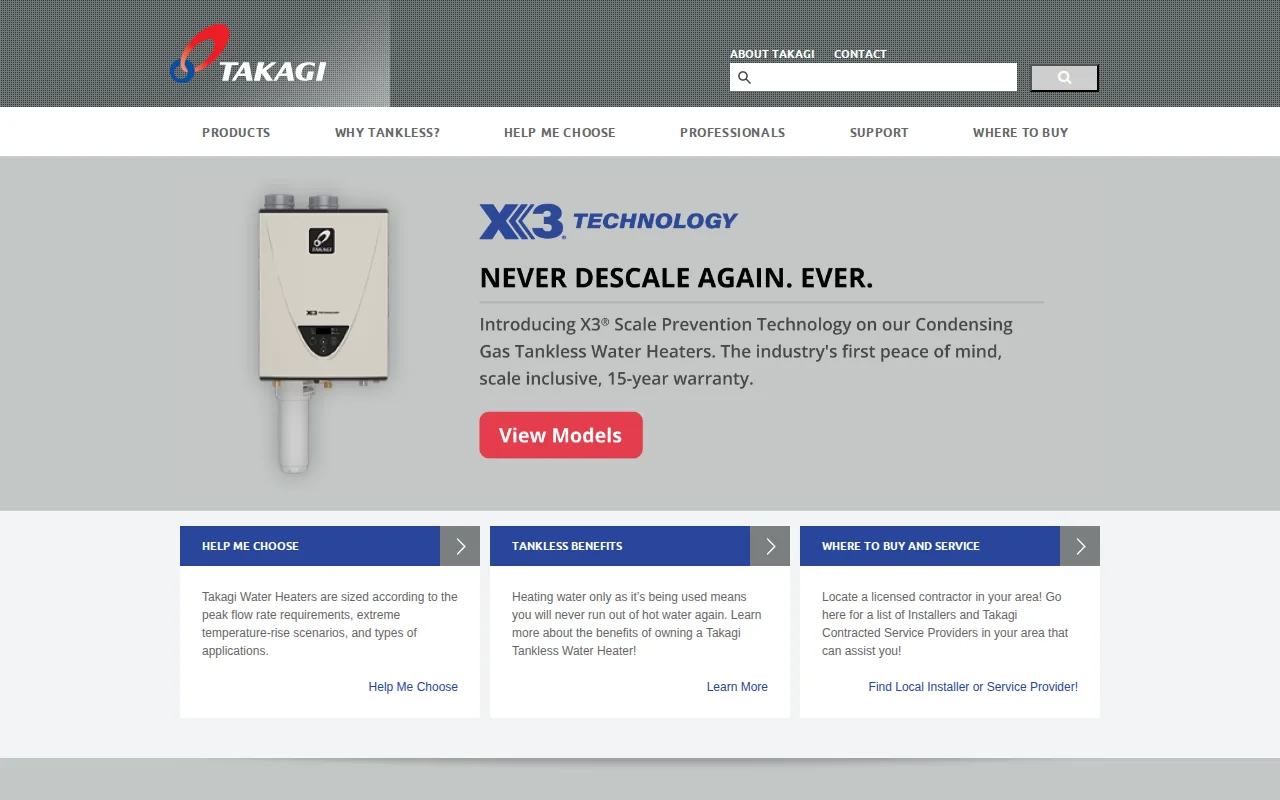
Takagi builds tankless water heaters sized for peak flow rate requirements rather than average demand, which is the right approach for larger homes. Their whole-house gas models deliver up to 10 GPM and handle three to four bathroom loads at once without temperature swings.
The brand's approach to sizing is worth noting. Takagi's official site emphasizes matching the unit to the home's extreme temperature-rise scenarios , not just average use , which matters in foothill communities where groundwater temperatures drop significantly in winter. A unit sized for summer inlet temperatures will underperform in January.
Takagi units are gas-fired, which means they're not eligible for the same rebate stack as heat pump water heaters. The IRS Section 25C federal credit ended for units placed in service after December 31, 2025, so there's no federal tax credit available for a 2026 gas tankless install. PG&E and SoCalGas do offer tiered rebates on qualifying high-efficiency gas units, but the amounts are lower than heat pump incentives.
The main selling point is reliability under simultaneous demand. If your household genuinely needs 10 GPM available at any moment, Takagi delivers it. If your demand is more staggered , one person showers in the morning, another at night , a heat pump water heater's slower flow rate becomes a non-issue and the efficiency advantage dominates.
7. Rinnai RL75iN — Efficient Gas Tankless for Whole‑House Use
Best for:Whole-house hot water with steady, efficient supply for 3-to-4-person households.
The Rinnai RL75iN delivers 7.5 GPM at a 0.82 UEF , a solid whole-house performer that costs less than the RU180iN while covering the needs of most average-sized California homes. It's the right size for a household that doesn't routinely run three fixtures at peak simultaneously but wants the security of on-demand hot water without a storage tank.
At 7.5 GPM, the RL75iN handles two showers and a kitchen faucet at once without complaint. Push it to three heavy-flow fixtures and you'll notice a slight reduction, but that scenario is rare in a 3-to-4-person home outside of holiday gatherings. The modulating burner adjusts output to match demand, which keeps efficiency up during low-demand periods.
Installation runs in the $2,000 to $6,000 range depending on the complexity of the gas and venting work. If you're replacing an existing tankless unit with the same venting configuration, you'll land at the lower end. A full tank-to-tankless conversion in a California home with Title 24 venting requirements adds cost. Knowing what to expect on heat pump and HVAC repair costs helps you budget realistically for the full project.
The RL75iN requires annual descaling in hard-water areas. Its 0.82 UEF is honest , good for a gas unit, but far below the 3.5+ UEF of the heat pump models above. For a household prioritizing long-term energy savings over upfront simplicity, the heat pump route is still the better financial decision in most California climates.
8. Stiebel Eltron Tempra 36 Plus — Warm‑Climate Tankless Water Heater
Best for:Warmer climates where groundwater temperatures stay relatively high year-round.
The Stiebel Eltron Tempra 36 Plus is an electric tankless unit rated at 7.5 GPM with an installed cost in the $2,000 to $6,000 range. It's a strong performer in warm climates because electric tankless efficiency is directly tied to the temperature rise required , lower groundwater temperature means more electricity to heat the same volume of water.
In the Central Valley and lower-elevation parts of Placer County, where groundwater stays warmer, the Tempra 36 Plus performs close to its rated flow. In higher-elevation Sierra foothill communities with cold winter groundwater, effective GPM drops and electricity consumption climbs. That's not a flaw in the unit , it's physics. Sizing for worst-case inlet temperature is the fix.
The Tempra 36 Plus uses Stiebel Eltron's Advanced Flow Control, which automatically reduces flow rate to maintain output temperature when demand exceeds capacity. You get consistently hot water, just at a lower flow. Some users find this frustrating; others prefer it to lukewarm water at full flow.
Electric tankless units like this one don't require gas lines or combustion venting, which simplifies installation in all-electric homes. But they draw significant amperage , the Tempra 36 Plus requires a 200-amp service with dedicated circuits. If your panel is already at capacity, factor in the electrical upgrade cost before comparing sticker prices.
9. Rheem RTEX-36 — Compact Electric Tankless Water Heater
Best for:Apartments, condos, and smaller homes where space is tight and gas isn't available.
The Rheem RTEX-36 delivers 8.8 GPM from a compact wall-mounted unit. It's a good fit for smaller households , typically two to three people , in all-electric buildings where a heat pump water heater's space requirements can't be met. No tank, no gas line, no combustion venting. It mounts to the wall and connects to your existing plumbing and electrical service.
The 8.8 GPM rating is higher than the Stiebel Eltron above, which gives it a bit more headroom for simultaneous use. In practice, the effective flow in cold-inlet conditions will be lower. For a condo in Sacramento or Roseville with mild groundwater temperatures, the rated flow is achievable for most of the year.
Rheem's installation documentation is thorough and widely available, which makes contractor quotes more consistent. The unit requires a dedicated 240V circuit, and most installations in California will need an electrical permit. Rheem's contractor network is large, so finding a licensed installer in Placer County is straightforward.
The RTEX-36 won't win on efficiency , electric tankless units have UEF scores well below heat pump models. But for a small home or condo where a heat pump water heater simply doesn't fit, it's a usable, reliable choice with a lower installed cost than most gas tankless alternatives.
10. Camplux Portable Propane — Mobile Tankless Water Heater
Best for:RV use, camping, off-grid cabins, and portable outdoor applications.
The Camplux portable propane tankless unit is in a completely different category from everything else on this list. It's not a whole-house solution. It delivers 1.32 GPM , enough for a single outdoor shower or a camp sink , and runs on propane without any electrical connection beyond a battery ignition.
For Placer and Nevada County homeowners who spend time at off-grid cabins in the Sierra Nevada, or who need hot water for a detached workshop or outdoor wash station, the Camplux fills a real gap. It's lightweight, portable, and doesn't require any permanent installation. You connect it to a propane tank, hang it on a wall or post, and you have hot water in minutes.
Don't try to use it as a primary home water heater. At 1.32 GPM, it can't supply a household shower at normal flow. It's a purpose-built tool for specific scenarios, and it does that job well. The propane consumption is modest for occasional use, and the unit is simple enough to maintain without professional service.
The installed cost listed in the research ($2,000 to $6,000) reflects professional installation scenarios and doesn't apply here , the Camplux is a consumer product you set up yourself. It's the only item on this list where DIY setup is the norm rather than the exception.
Quick Comparison of All Options
Here's how all ten options stack up across the decisions that matter most for a California homeowner choosing between heat pump water heater vs tankless technology.
Option | Type | UEF / Efficiency | Flow Rate (GPM) | Best Household Size | Key Limitation |
Home Worx Heating and Cooling | Local HVAC Installer | Depends on unit installed | Depends on unit installed | Any — Placer/Nevada County | Service area limited to Northern CA |
Rheem ProTerra XE80 | Heat Pump | 3.55 UEF | ~0.23 GPM | 4–6 people | Needs 700 cu ft air space; 50–55 dB noise |
Rheem ProTerra XE65 | Heat Pump | 3.75 UEF | ~0.20 GPM | 3–5 people | Slower recovery in heat-pump-only mode |
Bradford White AeroTherm 80-gal | Heat Pump | 3.45 UEF | ~0.23 GPM | 5+ people | 75 in tall, 210 lbs; needs overhead clearance |
Rinnai RU180iN | Gas Tankless | 0.96 UEF | 10 GPM | 4–5 people, 3+ baths | Annual descaling; cold-water sandwich |
Takagi | Gas Tankless | — | 10 GPM | 3–4 bathrooms simultaneously | No federal tax credit in 2026 |
Rinnai RL75iN | Gas Tankless | 0.82 UEF | 7.5 GPM | 3–4 people | Lower efficiency than heat pump options |
Stiebel Eltron Tempra 36 Plus | Electric Tankless | — | 7.5 GPM | Warm climates; moderate households | Performance drops with cold groundwater |
Rheem RTEX-36 | Electric Tankless | — | 8.8 GPM | Apartments, condos, small homes | Requires 240V dedicated circuit |
Camplux Portable Propane | Portable Propane Tankless | — | 1.32 GPM | RV, camping, off-grid | Not a whole-house solution |
The efficiency gap between heat pump and tankless is stark. Heat pump models average above 3.5 UEF; the best gas tankless unit here reaches 0.96 UEF. But the flow rate gap runs the other direction just as hard , gas tankless units average close to 7 to 10 GPM while heat pump units deliver under a quarter of a gallon per minute. For most California households, the heat pump wins on total cost of ownership. For households with high simultaneous demand and no suitable space for a heat pump unit, gas tankless is the usable answer. If you're unsure which category your home falls into, sizing your HVAC system correctly is the right starting point before committing to either technology.
Pro Tip:Before comparing units, check whether your utility space can accommodate a heat pump water heater's air-space requirement (700+ cubic feet). If it can, the efficiency math almost always favors heat pump over tankless for California homeowners on PG&E rates.
How to Choose Between Heat Pump and Tankless
Use this checklist to narrow down which technology fits your home:
Household size:4+ people with high daily demand? Heat pump 80-gallon. 1, 2 people in a condo? Electric tankless.
Available space:Heat pump units need 700+ cubic feet of air space and a stable ambient temperature above 40°F. If you don't have it, tankless wins by default.
Simultaneous demand:Three or more fixtures running at once regularly? Gas tankless at 10 GPM handles it. Heat pump flow rates won't.
Energy goals:Want to cut your water heating bill by 60% or more? Heat pump is the only technology that gets you there.
Gas availability:No gas line? Electric tankless or heat pump are your options. Gas tankless requires an existing gas supply and often a larger line.
Rebates and incentives:Heat pump water heaters qualify for significantly larger California utility rebates than gas tankless units. Factor this into the net cost comparison.
Noise tolerance:Heat pump units run at 50, 55 dB. Fine in a garage, noticeable in a living space.
According to the U.S. Department of Energy , heat pump water heaters can reduce water heating electricity use by up to 75% compared to standard electric models , the strongest efficiency argument for the technology in any head-to-head comparison.
FAQ
Is a heat pump water heater better than tankless for a California home?
For most California homeowners, yes , a heat pump water heater is the better long-term choice. It runs at a UEF above 3.5, compared to 0.82 to 0.96 for gas tankless units, and qualifies for larger PG&E and state rebates. The exception is households with high simultaneous hot-water demand, where a gas tankless unit's 7 to 10 GPM flow rate is the usable requirement. Space constraints matter too , heat pump units need 700+ cubic feet of air around them.
What is the main downside of a heat pump water heater?
Flow rate is the biggest limitation most people don't expect. Heat pump water heaters deliver roughly 0.20 to 0.23 GPM , far lower than the 7 to 10 GPM of gas tankless units. They also need significant air space, run at 50 to 55 dB, and cost more upfront than a standard tank. Recovery time is slower in heat-pump-only mode, though the large tank buffer means most households never notice it in daily use.
How much does it cost to install a heat pump water heater in Placer County?
Average installed cost in the Placer County area runs around $1,695 to $2,500 for a straightforward replacement. If your home needs electrical panel work or the space requires modifications to meet the 700-cubic-foot air requirement, costs can climb higher. Home Worx Heating and Cooling offers financing at approximately $120 per month, and PG&E rebates can reduce the net cost further. Get a site assessment before committing to a budget.
Can a tankless water heater run out of hot water?
A properly sized gas tankless water heater won't run out of hot water , it heats on demand as long as the tap is open. But it can be overwhelmed. If you exceed its rated GPM by running too many fixtures at once, it will either reduce flow or deliver lukewarm water. A 10 GPM unit like the Rinnai RU180iN handles most household peak scenarios, but very large homes with staggered demand may need two units or an oversized model.
Do heat pump water heaters work in cold garages?
They work, but efficiency drops when ambient air falls below about 50°F. Below 40°F, most models switch to electric resistance heating , which is less efficient and costs more to run. In a Sierra Nevada foothill home with an uninsulated garage that gets cold in January, the heat pump will spend more time in resistance mode during winter months. An insulated garage or indoor utility room is a better installation location for year-round heat pump efficiency.
What's the lifespan difference between heat pump and tankless water heaters?
Gas tankless water heaters typically last 20 years with proper annual descaling. Heat pump water heaters have a more complex design , compressor, fan, and tank , and generally last 12 to 15 years. The shorter lifespan is partly offset by lower operating costs and larger rebate eligibility. Factor both lifespan and annual energy cost into any total cost of ownership comparison between the two technologies.
The Right Choice for Your Home
For most Placer County and Nevada County homeowners, a heat pump water heater is the smarter long-term investment , lower operating costs, bigger rebates, and a smaller carbon footprint. The gas tankless units on this list are the right answer when space or simultaneous demand makes heat pump technology impractical. If you're ready to figure out which option fits your home, contact Home Worx Heating and Cooling for a site assessment and a straight answer on what makes sense for your specific setup.