
Best Whole House Air Purifier Options for 2026
- Bryn Fortmuller
- Aug 2
- 11 min read
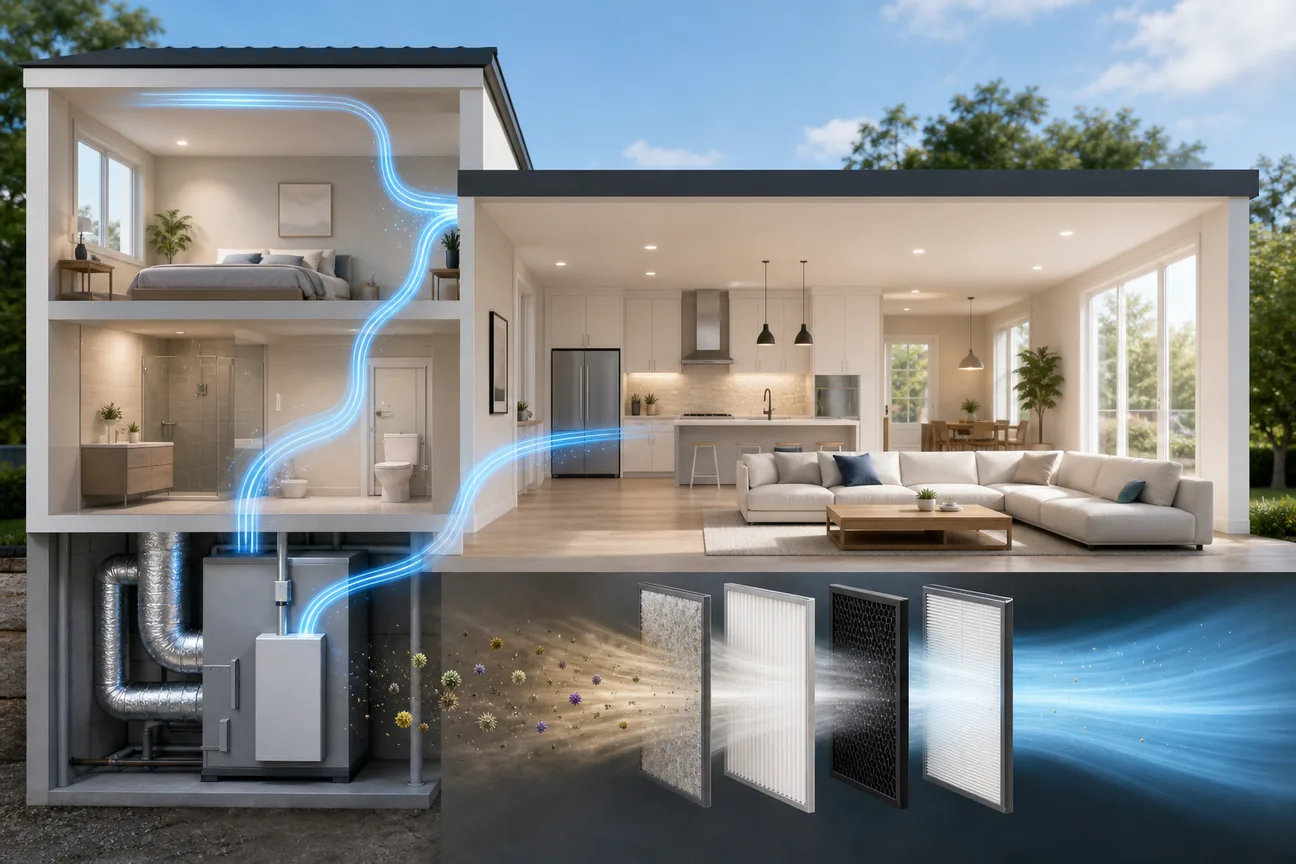
A portable purifier humming in one room can only do so much. A whole house air purifier works through your HVAC system to clean every room at once, catching allergens, smoke, pet dander, and pathogens before they reach your lungs. Here are the ten best options right now, and who each one is actually for.
Table of Contents
1. Home Worx Heating and Cooling — Whole-Home IAQ Solutions (Our Top Pick)
2. High-Efficiency UV/PCO Whole-House Air Purifier — Best HEPA-Grade Whole-House Filtration
3. Electrically Enhanced Media Air Cleaner — Best MERV 16 Media Filter for Allergy Sufferers
4. In-Duct Needle-Point Bipolar Ionizer — Best In-Duct Ionizer for Odor and Pathogen Control
5. UV + Ionizer Combo Air Purifier — Best UV + Ionizer Combo for Whole-Home Coverage
6. Whole-Home Electronic Air Cleaner — Best Electrostatic Precipitator for Large Homes
7. Smart-Integrated Whole-House Air Purifier — Best Smart Home Integration
8. High-Efficiency Electronic Air Cleaner — Best for Wildfire Smoke and Wildfire-Prone Regions
9. In-Duct UV + Media Filtration System — Best Budget-Friendly Whole-House UV System
10. Aprilaire 2410 — Best Low-Maintenance Media Filter for Retrofits
How to Choose the Right Whole House Air Purifier for Your Home
1. Home Worx Heating and Cooling — Whole-Home IAQ Solutions (Our Top Pick)
Home Worx Heating and Cooling is a family-owned HVAC contractor serving Placer County and Nevada County, including Auburn, Colfax, Rocklin, Roseville, Lincoln, and Grass Valley. They're our top pick because they don't just sell a box , they assess your home's actual air quality needs and install the right technology for your specific setup.
What sets them apart is the range. Home Worx installs whole-house HEPA-grade filters, UV light air sanitizers, bipolar ionization systems, and high-efficiency media filters. They also handle duct cleaning and sealing, which matters because a leaky duct system undermines even the best purifier. If your evaporative coil is contaminated , a common problem that comes up repeatedly in whole-home IAQ assessments , they address that too, not just the filter.
For homeowners in the Sierra foothills, where wildfire smoke rolls in during summer and dry winters create their own dust problems, having a local contractor who knows the regional conditions is a real advantage. Home Worx offers 24/7 emergency service, financing options, and maintenance contracts so your system stays effective year-round. They can also help you handle PG&E rebates and California energy efficiency programs tied to qualifying IAQ upgrades.
If you want a whole-house air quality solution in Lincoln or the surrounding Placer County area , Home Worx is the team to call. They'll match the technology to your home rather than upselling you on equipment you don't need.
The one caveat: they serve a defined geographic area. If you're outside Placer and Nevada Counties, you'll need one of the product-only options below and a local installer.
2. MERV 16 + UV-C + PCO Combo Systems — Best HEPA-Grade Whole-House Filtration
Some whole-house air purifiers combine a high-efficiency MERV 16 media filter with UV-C light and photocatalytic oxidation (PCO) to attack particles, pathogens, and odors in a single unit. This type of filter approaches true HEPA performance, catching particles down to very small sizes at high efficiency rates.
This is the most thorough whole-house system available. The combination of mechanical filtration plus UV plus PCO means it handles what standard filters miss: volatile organic compounds (VOCs), mold spores, and airborne bacteria. The UV-C stage targets pathogens in the duct stream before they circulate through the home.
The tradeoff is cost. Replacement filters can run over $100, and the PCO cells need periodic replacement too. Some systems are brand-specific and won't work with other HVAC equipment. Budget for the ongoing consumable costs before committing.
3. High-Efficiency Media Filter — Best for Allergy Sufferers
Some whole-house media filters use electrically enhanced air filtration — a hybrid of electronic and media technologies. This type of filter can perform at a higher effective filtration level than its base MERV rating suggests. Units in this category typically capture a high percentage of fine particles across the 0.3–10.0 micron range.
For allergy households, those numbers matter. Dust mite fragments, mold spores, and pet dander mostly fall in the 1–10 micron range, and this filter tier handles that very well. Unlike plate-type electronic air cleaners, quality media filters run silently — no snapping or popping sounds.
Maintenance is simple. You replace the media filter once a year and wipe down the internal components. That's it. For families who want strong allergy protection without monthly upkeep, this category is hard to beat. It does require professional installation, so confirm compatibility with your existing ductwork before ordering.
Pro Tip:If you're managing allergy symptoms, pair a high-efficiency media filter with continuous fan operation on your thermostat. Running the fan on "ON" rather than "AUTO" keeps air cycling through the filter all day, not just during heating or cooling cycles — which dramatically increases the volume of air cleaned each hour.
4. In-Duct Bipolar Ionizer — Best for Odor and Pathogen Control
A self-cleaning, needle-point bipolar ionization unit mounts directly inside your HVAC system's air handler or ductwork. It produces positive and negative ions that attach to airborne particles, making them heavier so they fall out of the breathing zone or get captured by the filter downstream.
What makes ionization worth considering alongside a standard filter is its reach. Ions travel through the duct system and into occupied rooms, acting on particles and pathogens throughout the home, not just at the filter. For odor control (cooking smells, pet odors, smoke), ionization works faster than media filtration alone.
A self-cleaning ionizer means no consumable parts to replace, which keeps operating costs low after the initial install. The main caveat: ionization alone isn't a substitute for a high-MERV filter. It works best as a complement to mechanical filtration, not a replacement. Also confirm the unit is UL 2998 certified for zero ozone output before installation — this matters in California, where air quality standards are strict.
5. UV + Ionizer Combo Systems — Best for Whole-Home Coverage
Some whole-house air purifiers combine UVC light with an advanced catalyst to produce low concentrations of airborne hydrogen peroxide, plus bipolar ions that disperse through your air-conditioned space. The concept replicates the natural outdoor process where sunlight and UV radiation break down microorganisms and airborne contaminants.
Quality units in this category are CARB certified and meet California's ozone emissions limits, which is important for homeowners in the state. These systems install in existing ductwork and work with virtually any ducted air conditioning system, residential or commercial. Many include a built-in indicator that shows when the UV cell needs replacement, removing the guesswork from maintenance.
UV plus ionizer systems are particularly effective at reducing odors and tackling airborne bacteria and viruses that pass right through standard filters. Energy draw is typically minimal. The UV cell generally needs replacement every one to two years, which adds to the ongoing cost. These are proactive air treatment systems — they work best paired with a decent MERV-rated filter for particle capture.
6. Whole-Home Electronic Air Cleaner — Best Electrostatic Precipitator for Large Homes
A whole-home electronic air cleaner with a 3-stage air cleaning system can achieve a high initial MERV rating. Units in this category are claimed to be significantly more efficient at capturing airborne particles than a standard 1-inch filter. The electrostatic postfilter charges particles as they pass through, then traps them on collector plates.
For large homes up to 2,000 square feet, this type of system handles the volume without adding fan resistance that could stress your HVAC system. Because it has no fan of its own, it produces no additional noise , you'll only hear your existing HVAC system. Occasionally a faint snapping sound occurs from the high-voltage discharge; that's normal operation.
Maintenance requires replacing the postfilter every six months. Don't wash it , the electric charge is what makes it work, and water destroys that. Some manufacturers back their electronic air cleaners with long-term coil guarantees, which cover coil cleaning costs if the unit is properly maintained. That's a meaningful warranty for a whole-home system. The tradeoff: no filter replacement indicator, so you'll need to track the schedule yourself.
Key Takeaway:Electrostatic precipitators offer very high particle capture efficiency but require consistent maintenance , skip a postfilter change and performance drops significantly.
7. High-MERV Smart-Integrated Air Purifier — Best Smart Home Integration
Some whole-home air purifiers offer high-MERV-level filtration while maintaining airflow comparable to a lower-MERV filter. That balance matters because high-MERV filters can restrict airflow enough to cause coil freezes and efficiency losses , systems engineered for smart integration are designed to avoid that problem.
Where these units stand out is integration. Certain models are designed to work within a specific HVAC brand's ecosystem, which means they can communicate with compatible thermostats and smart home setups. You get air quality data and system status without having to physically check the unit. For homeowners who manage their home systems through an app, that visibility is genuinely useful.
Installation typically requires a certified dealer, and the system is often optimized for the matching HVAC equipment. If you're already in a compatible ecosystem, this is the natural upgrade path. If you're not, the cost of switching HVAC brands to access it likely isn't worth it. Filter changes are straightforward , a few times per year , and the unit operates quietly inside the air handler.
8. Electronic Air Cleaners — Best for Wildfire Smoke and Wildfire-Prone Regions
Whole-house electronic air cleaners are designed to capture fine particles, including wildfire smoke particulate (PM2.5). For homeowners in wildfire-prone regions like Placer County and Nevada County, where smoke events have become a recurring summer reality, fine-particle capture rate is the key spec to evaluate when choosing a system.
These units work in conjunction with your HVAC system, and performance depends on regular maintenance. The collector cells need washing every three to six months. Skip that, and efficiency drops fast. But when maintained properly, electronic air cleaners outperform most media filters on the finest particles — exactly the ones that penetrate deepest into the lungs during smoke events.
Energy use is higher than a passive media filter, and the upfront cost is significant. For homeowners in high-smoke-risk areas, an electronic air cleaner is among the most capable options in its class for fine-particle protection. A qualified HVAC technician can help you identify which system is compatible with your existing equipment and best suited to your home's needs.
9. Budget-Friendly Whole-House UV Systems — An Affordable In-Duct Option
Budget-friendly whole-house UV air purification systems sit at the more affordable end of the whole-house air purification market. A UV filtration system with professional installation typically runs up to $800, compared to pricing that varies considerably for a hybrid UV/mechanical system, and entry-level products consistently land in that lower range.
These systems combine UV sterilization with media filtration in a compact in-duct package. They target mold, bacteria, and airborne viruses that pass through standard filters. For homeowners who want UV protection without the cost of a premium brand, a budget-tier in-duct UV system is a usable entry point.
The tradeoff is that UV bulbs need replacement every one to two years, adding to the ongoing cost. Performance data on fine particles (PM2.5) is less strong than what premium brands publish. This is a solid choice for a budget-conscious upgrade, but if wildfire smoke or severe allergies are the main concern, step up to a higher-MERV media system.
10. Aprilaire 2410 — Best Low-Maintenance Media Filter for Retrofits
The Aprilaire 2410 uses a 6-inch media cabinet with MERV 13 standard filtration. That 6-inch depth is what separates it from the crowd of 4-inch competitors , more filter material means longer intervals between changes, typically 12 months for most households. Replacement media runs $35, $55, higher than generic 4-inch filters but justified by the longer lifespan and better sealing.
For retrofit situations , swapping out an old 1-inch filter slot for a proper whole-house media cabinet , the 2410 is one of the cleanest installations available. The cabinet design accommodates most standard return duct configurations, and Aprilaire's pressure-drop indicators tell you when the filter actually needs changing rather than guessing by the calendar.
It's the right pick for allergy households and anyone in a wildfire region who wants reliable MERV 13 performance with minimal fuss. If your existing ductwork already has an Aprilaire cabinet installed, keep buying Aprilaire media , switching brands requires a full duct modification that rarely makes financial sense. For homes without any existing media cabinet, the step-by-step guide to reducing home allergies through your HVAC system walks through filter selection and fan settings in detail.
How to Choose the Right Whole House Air Purifier for Your Home
The right system depends on four things: your home's square footage, your HVAC brand, your primary air quality concern, and how much maintenance you'll actually do.
Primary Concern | Best Technology | Maintenance Level | Typical Cost Range (installed) |
Allergies / pollen / pet dander | MERV 13–16 media filter | Low (annual filter) | $400–$1,200 |
Wildfire smoke (PM2.5) | Electronic air cleaner or MERV 16 | Medium (cell cleaning) | Pricing varies — contact a local HVAC contractor for a quote |
Odors / VOCs | Ionizer or UV + ionizer combo | Low to medium | $600–$1,500 |
Bacteria / viruses / mold | UV-C light system | Medium (bulb replacement) | $600–$800 |
Full-spectrum protection | MERV 16 + UV + PCO combo | Medium to high | Pricing varies — contact a local HVAC contractor for a quote |
MERV rating is the first number to understand. The Minimum Efficiency Reporting Value (MERV) runs from 1 to 20. Most residential HVAC systems work well with MERV 8, 13. Go higher and you get better filtration but more airflow restriction, which is why high-performance whole-house air cleaners are engineered to deliver high filtration with lower pressure drop.
For homes in Northern California's Sierra foothills, wildfire smoke is a real seasonal factor. Fine particles (PM2.5) require at minimum MERV 13, and ideally MERV 16 or an electronic air cleaner with high submicron efficiency. UV systems add pathogen control but don't replace mechanical filtration for particles.
Installation costs vary by system type. A basic media filter upgrade runs a few hundred dollars. A full UV plus MERV 16 combo system can reach significantly higher installed costs. Factor in ongoing filter or bulb replacement costs when comparing options — a lower-cost system with higher annual media costs may cost more over five years than a higher-upfront system with lower annual costs.
Home Worx Heating and Cooling can assess your existing ductwork, HVAC equipment, and home size to recommend the right fit. That kind of on-site evaluation prevents the common mistake of buying a system that's incompatible with your air handler or too restrictive for your duct configuration.
Frequently Asked Questions
What does a whole house air purifier actually do?
A whole house air purifier installs inside your HVAC system and filters or treats air as it circulates through your home's ductwork. Unlike portable units that clean one room at a time, these systems work on every room served by your heating and cooling system. Depending on the technology, they can remove particles, neutralize pathogens, reduce odors, or do all three simultaneously.
What MERV rating do I need for allergies or wildfire smoke?
For allergies, MERV 11, 13 handles most common triggers like pollen, pet dander, and dust mite fragments. For wildfire smoke, you want MERV 13 at minimum and ideally MERV 16 or an electronic air cleaner rated for submicron particles. The key is that PM2.5 smoke particles are very small , standard MERV 8 filters let most of them pass through.
How often do whole house air purifiers need maintenance?
It depends on the technology. Media filters like the Aprilaire 2410 need replacement once a year. Electronic air cleaners like the Honeywell F300 require a postfilter swap every six months. UV systems need bulb replacement every one to two years. Ionizers like the iWave-R are largely maintenance-free after installation. Always follow the manufacturer's schedule , skipping maintenance drops efficiency significantly.
Can I install a whole house air purifier myself?
Some media filter upgrades are DIY-friendly if you're replacing an existing filter cabinet. But UV systems, electronic air cleaners, and ionizers require electrical connections inside the air handler and should be installed by a licensed HVAC technician. In California, certain system modifications also require permits. A professional installation ensures the unit is positioned correctly and wired safely.
Do whole house air purifiers use a lot of electricity?
Most use very little on their own. The Honeywell F300 draws 36 watts. The RGF REME HALO uses 17 watts. Media filters use no electricity at all , the existing HVAC blower does all the work. Electronic air cleaners consume slightly more but are still far below typical household appliances. The bigger energy factor is whether a high-MERV filter restricts airflow and forces your HVAC to work harder.
Is a whole house air purifier better than a portable air purifier?
For whole-home coverage, yes. A portable unit cleans the room it's in and nothing else. A whole house system treats air throughout every room connected to your ductwork, including bedrooms while you sleep. It also protects your HVAC equipment by keeping the evaporative coil cleaner, which improves system efficiency over time. For single-room needs, a portable unit is fine , but it can't replace whole-home treatment.
Conclusion
For most homeowners in Placer County and Nevada County, the right move is to start with a professional assessment rather than buying a system blind. Home Worx Heating and Cooling serves the Auburn, Colfax, Rocklin, Lincoln, Grass Valley, and Penn Valley areas with full IAQ installations, from high-efficiency media filters to UV and ionization systems. Contact Home Worx to get a recommendation matched to your home's actual ductwork, HVAC equipment, and air quality needs.