
Gas Furnace vs Heat Pump Cost in California
A heat pump can cost more to install than a gas furnace, yet still cost less to run in the Sierra foothills. The reason is simple: it moves heat instead of making it. We’ll compare installed price, energy use, cold-weather comfort, upkeep, rebates, and total ownership cost for homes in Placer and Nevada counties.
We pulled 39 months of EIA data on California residential natural gas prices, plus the agency's newest statewide electricity rate. Gas averaged $22.00 per thousand cubic feet over the trailing 12 months, equal to 9.1 cents per kWh of heat from an 80% AFUE furnace. Electricity averaged 32.83 cents per kWh, so a heat pump needs a COP above 3.6 to beat it, or 4.4 for a 96% model. That threshold, not the fuel type, decides which system actually costs less to run in the Sierra foothills.
Table of Contents
1. Home Worx Heating and Cooling: Get a Local Cost Comparison
Home Worx Heating and Cooling is our recommended first stop when you need a local gas furnace versus heat pump cost comparison. We’re a family-owned HVAC team based in Colfax, serving homeowners across Placer and Nevada counties.
A useful quote should show more than the equipment price. It should explain the system size, efficiency rating, ductwork condition, electrical work, permit needs, expected fuel use, and any rebate that may apply. Otherwise, two quotes can look far apart even when the systems are close in quality.
Home Worx Heating and Cooling offers both gas furnaces and heat pumps. That lets us compare the options around your home instead of pushing one system for every job. A home in Auburn may have different needs from one in Grass Valley, Rocklin, Roseville, Penn Valley, or Lincoln, even when the floor plans are similar.

Ask for two written paths:
A furnace-only replacement, if your air conditioner is still in good shape.
A complete heat pump replacement, if heating and cooling equipment both need work.
A 96% AFUE condensing furnace, with an average installed cost of $12,000 ($9,800-$14,200).
Our heat pump installation cost options explain why project prices vary so much. Home size, access, duct changes, equipment choice, and electrical capacity all affect the final number. A local estimate also accounts for foothill conditions that a broad California average can miss.
Gas Furnace vs Heat Pump Cost: Upfront Installation
The first difference in gas furnace vs heat pump cost is the installation bill. A standard gas furnace is often less expensive when it replaces an existing furnace in Auburn and Colfax. A heat pump can look more costly because it replaces the heating and cooling function with one system.
Cost factor | Gas furnace | Heat pump |
Typical collected California range | $4,500 to $12,500 | $5,000 to $27,500 |
Example standard system | About $7,500 for an 80% AFUE furnace | Mitsubishi Hyper‑Heat Heat Pump averages about $17,000 installed |
Cooling equipment | Needs a separate air conditioner | Built into the same system |
Common added work | Venting, gas connections, or duct repairs | Electrical work, controls, duct changes, or backup heat |
Best price comparison | Furnace-only replacement | Furnace plus air conditioner replacement |
These figures are planning ranges, not bids for a specific home. One research set puts a standard 80% AFUE furnace at $7,500 installed, with a range of $5,500 to $9,500. A high-efficiency 96% AFUE condensing furnace in that same set averages $12,000. Rocklin and Roseville homeowners can use these figures as a starting point.
Heat pumps run across a wider price band. A basic heat pump installation may sit near the lower end. A large system, difficult retrofit, or geothermal design can move far higher. One listed geothermal average reaches $27,500, but most foothill homeowners are comparing heat pump equipment. Grass Valley and Penn Valley homeowners should compare the full installation scope.
Gas also needs a fair comparison. If the furnace is replacing both an old furnace and an aging AC, the heat pump’s higher equipment price may be much less noticeable. You’re comparing one combined system with two separate systems.
California’s rules and incentive programs also affect the choice. The basic heat pump design reverses its cycle, so it can heat in winter and cool in summer. Ask Home Worx Heating and Cooling to confirm current PG&E and state programs before counting a rebate in your budget. For Lincoln homeowners, contact Home Worx Heating and Cooling for a local comparison.
Energy Bills and Efficiency in Grass Valley and Penn Valley
Energy use is where the gas furnace vs heat pump cost debate gets more interesting. Gas is often cheaper per unit of energy, but a furnace creates heat by burning fuel. A heat pump moves existing heat, so it can produce several units of heat for one unit of electricity.
Gas furnaces use AFUE, or annual fuel utilization efficiency. An 80% AFUE furnace turns about 80% of its fuel energy into useful heat. The rest leaves through the exhaust system. A 96% model wastes less fuel, though its purchase price can be higher. The AFUE definition and rating method help explain why two furnaces can use different amounts of gas for the same job.
Heat pumps use measures such as COP, SEER2, and HSPF2. COP tells you how much heat the system delivers compared with the electricity it consumes. A COP of 3 means the system delivers three units of heat for each unit of electric energy used under those test conditions.
The research range puts heat pump annual energy costs near $580 to $1,200 in some cases. A conventional gas furnace estimate reaches about $2,650 per year. Those numbers can’t predict your bill. Rates, insulation, thermostat settings, system size, and indoor temperature all matter.
Grass Valley and Penn Valley have colder winter nights than many coastal parts of California. That reduces a heat pump’s advantage during the coldest hours. Still, a properly sized heat pump can work well through much of the season, especially when the home has good air sealing and insulation.
PG&E rate plans deserve attention too. A heat pump shifts more of your heating use onto the electric bill. An electricity rate plan may reward careful scheduling, but the best choice depends on your full household load. Solar can also change the result, though it shouldn’t be treated as free energy.
Key Takeaway:Compare projected heating cost against your actual PG&E and gas bills, not against a national average.
We can model the difference for homes in Colfax, Rocklin, Roseville, Auburn, or Lincoln. Those homes may face hotter summer cooling loads than a home in the higher foothills, which makes the heat pump’s cooling function more valuable. Contact Home Worx Heating and Cooling for a local comparison.
Winter Performance, Summer Cooling, and Comfort
Cold-weather performance can change the gas furnace vs heat pump cost decision. A furnace produces heat as long as gas and electricity are available. It also sends warm air quickly, which many homeowners prefer during a sharp overnight chill.
A heat pump works differently. It takes heat from outdoor air, then moves that heat indoors. As outdoor temperatures fall, the system may work harder and deliver less heat. Some heat pump designs are built for much lower temperatures, but model choice and sizing still matter.
That matters in Auburn, Lincoln, Colfax, and Rocklin, where summer cooling can be a major part of annual HVAC use. A heat pump handles cooling without a second outdoor AC unit. If you replace both heating and cooling at once, that single-system setup can narrow the upfront price gap.
Higher-elevation homes need a closer look. A system that works well in Roseville may not be the right match for a home near the colder edges of Nevada County, including Grass Valley and Penn Valley. We check the heat load, outdoor design conditions, duct airflow, and backup heat plan before choosing equipment.
Comfort is more than supply-air temperature. Heat pumps often run for longer periods at a lower output. That can reduce large temperature swings. Furnaces tend to run in shorter, hotter bursts. Some people like that quick heat, while others prefer steadier room temperatures.
A combined heating setup gives you both modes. The heat pump handles milder weather. The gas furnace takes over at a set outdoor temperature or when the heat pump needs help. Our heating system options explain the changeover idea in plain terms.
There’s no universal winner for comfort. If fast recovery during cold snaps is your top concern, gas has a clear edge. If you want one system for year-round use, a heat pump may fit better.
For a local comparison, contact Home Worx Heating and Cooling for service in Placer and Nevada counties.
Maintenance, Lifespan, Rebates, and Total Ownership Cost
Maintenance adds to the gas furnace vs heat pump cost over time. Both systems need clean filters and good airflow. A blocked filter makes the blower work harder and can reduce comfort in homes from Auburn to Colfax.
A gas furnace also needs checks for burners, ignition parts, venting, and the heat exchanger. The heat exchanger keeps combustion gas away from indoor air. Any concern with that part needs prompt professional attention, whether you live in Rocklin or Roseville.
A heat pump needs outdoor coil cleaning, refrigerant checks, electrical inspections, and filter care. Because it heats and cools, it may run across more months of the year. That does not make maintenance optional. It makes a service plan more useful.
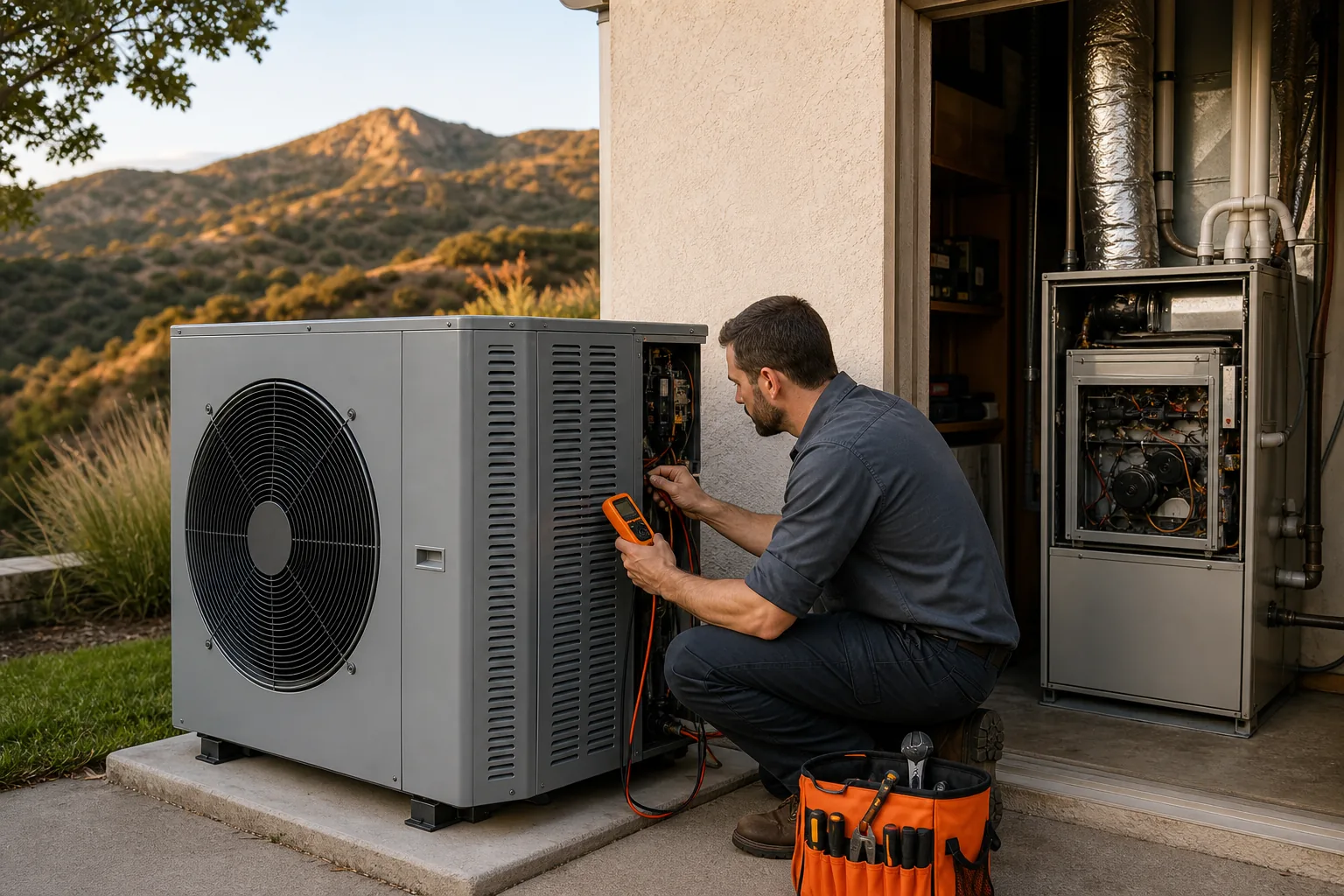
Available lifespan data is limited, but the collected figures are close. One source lists gas furnaces at about 18.5 years. Geothermal heat pumps are listed at 20 to 25 years, while another comparison puts common heat pumps closer to 12 to 15 years. Installation quality, run time, sizing, and service history explain much of that spread.
Rebates can change the math quickly. Heat pump programs may depend on household income, equipment qualification, utility territory, and installation rules. Programs can also change, so don’t assume a rebate from an old quote still applies for homes in Grass Valley or Penn Valley.
Home Worx Heating and Cooling can help you check PG&E and California incentive paths during the estimate. We can also flag permit work in Placer County and explain whether an electrical upgrade or duct repair affects the final price for homeowners in Lincoln. Get the expected rebate shown as a separate line, not buried in a discount.
Pro Tip:Ask for a 10-year ownership view that includes installation, maintenance, fuel use, cooling, and the net price after verified incentives.
A furnace may win when you need only a low-cost heating replacement and your AC still has years left. A heat pump often wins when both systems are near replacement, because one system covers both jobs. The right answer comes from the whole equipment plan. Contact Home Worx Heating and Cooling for local service in Auburn, Colfax, Rocklin, Roseville, Grass Valley, Penn Valley, and Lincoln.
Which Costs Less for Your Home?
The lower gas furnace vs heat pump cost depends on what you’re replacing and how long you’ll stay. A gas furnace is usually the cheaper first purchase when the existing AC works well and the gas line is already in place.
A heat pump deserves the stronger look when your AC is also old. Its installation price may be higher than a furnace alone, but you avoid buying a separate cooling system. Lower energy use can then reduce the gap over the years.
Your situation | Likely better fit | Reason |
Furnace failed, AC is fairly new | Gas furnace | Lower project scope and less electrical change |
Furnace and AC both need replacement | Heat pump | One system handles both functions |
Older home with limited electrical capacity | Gas furnace or a system with backup heat | May avoid panel work during a rushed replacement |
Home has good insulation and solar | Heat pump | Efficient electric heating may produce stronger savings |
High-elevation home with hard cold snaps | Gas furnace or a system with backup heat | Backup heat can protect comfort during extreme weather |
Short ownership horizon | Lower-net-cost option | Upfront price matters more than long payback |
For homeowners in Grass Valley, Penn Valley, or Colfax, we usually want to see the home’s heat loss before making a call. A large furnace can cycle badly. An undersized heat pump can run too long during a cold snap. Correct sizing matters more than a flashy efficiency number.
Homeowners in Rocklin, Roseville, Auburn, and Lincoln may place more value on efficient summer cooling. A heat pump can make sense there even when winter savings alone look modest. That is why a complete quote should show heating and cooling together.
Our decision rule:choose the furnace when it solves a smaller, immediate problem at the lowest verified net cost. Choose the heat pump when you’re replacing both sides of the system and plan to stay long enough to benefit from lower operating use. Choose a system with backup heat when cold-weather backup matters most.
FAQ
Is a heat pump cheaper than a gas furnace in California?
A heat pump is often cheaper to run, while a gas furnace is often cheaper to install by itself. The comparison changes when you include air conditioning, rebates, electrical work, and maintenance. In Northern California communities such as Auburn, Colfax, Rocklin, and Roseville, a heat pump may make the most financial sense when the furnace and AC need replacement together.
How much does a heat pump cost compared with a furnace?
A heat pump may cost about $5,000 to $27,500 installed, while collected furnace estimates range from about $4,500 to $12,500. Those are broad planning figures, not a quote. Home size, duct condition, equipment efficiency, access, permits, and electrical changes can move the final price.
Do heat pumps work in Grass Valley and Penn Valley?
Yes, heat pumps can work in Grass Valley and Penn Valley when the equipment is sized for the home and designed to operate in local cold conditions. A backup heat source may help during unusually cold weather. Ask the installer to show expected capacity at low outdoor temperatures, not just the headline efficiency rating. Homeowners in Lincoln should ask the same questions.
Should I replace my gas furnace with a heat pump?
Replace a gas furnace with a heat pump when you also need new cooling, want one system for both jobs, and can support the electrical load. Keeping gas may make more sense when the AC is new or the project must stay within a tight budget. A backup heating arrangement is another option.
Do heat pumps need more maintenance than gas furnaces?
Heat pumps need regular filter and outdoor-coil care because they heat and cool through the year. Gas furnaces need burner, vent, ignition, and heat-exchanger checks. Neither system should be judged by maintenance alone. Poor airflow and skipped service can raise repair risk for either choice. Contact Home Worx Heating and Cooling for local service.
Conclusion
For most foothill homes replacing both heating and cooling, we’d price a heat pump first, then compare it with a gas furnace and dual-fuel option. If the AC is healthy or your electrical service is limited, a furnace may be the cleaner short-term choice. Homeowners in Auburn, Colfax, Rocklin, Roseville, Grass Valley, Penn Valley, and Lincoln can contact Home Worx Heating and Cooling for a written local comparison and a check of current rebate options.