
UV Light for HVAC System: Installation Guide
A UV light can help keep an HVAC coil cleaner, but the lamp's wavelength isn't the only detail that matters. Most units use nearly the same UV-C band. Power draw, airflow, placement, and safe service matter more.
We'll walk through the process in five steps. The goal is a properly sized system that fits your home, your ductwork, and the hot summers and cold winters of Northern California.
Table of Contents
Step 1: Assess Your HVAC System and Indoor Air Goals
Before choosing a UV light for your HVAC system, decide what you want it to do. A coil lamp treats the wet evaporator coil and drain pan inside the air handler. An in-duct lamp treats air as it moves past the bulb.
These are different jobs. A coil is a fixed target, so the lamp can shine on it for long periods. Airborne particles move past an in-duct lamp in a short burst. That means the lamp needs enough intensity and exposure time to deliver a useful dose.
Start with a basic system check. Find the furnace or air handler. Note the filter size and the available space near the evaporator coil. Look for a service panel that gives a technician safe access without placing the lamp against insulation, wiring, seals, or plastic parts.
Then write down the problem you want to solve:
Musty odor near the supply vents may point to damp coil or drain-pan growth.
Pollen, dust, and pet dander call for better mechanical filtration.
Wildfire smoke needs a filter plan that addresses fine particles.
Moisture problems need drain work or humidity control before UV treatment.
UV-C can inactivate some microbes, but it doesn't catch inert particles. A lamp cannot treat what the light cannot reach.
Check your home's layout too. A long duct run, a cramped crawlspace, or an older air handler may affect access. In Auburn and Colfax, older homes may need a closer look at duct condition before adding another device inside the system. Rocklin and Roseville homes may also have different access constraints.
If the duct has leaks, poor insulation, or crushed flex duct, fix those issues first. A UV lamp can't correct lost airflow. Our team at Home Worx Heating and Cooling can inspect the air handler and help match the air-quality goal to the equipment already in place.
By now you should have a clear target, such as coil hygiene, odor control, or layered particle control. That target decides the lamp type and its location. Homeowners in Grass Valley, Penn Valley, and Lincoln can use the same assessment before scheduling local HVAC work.
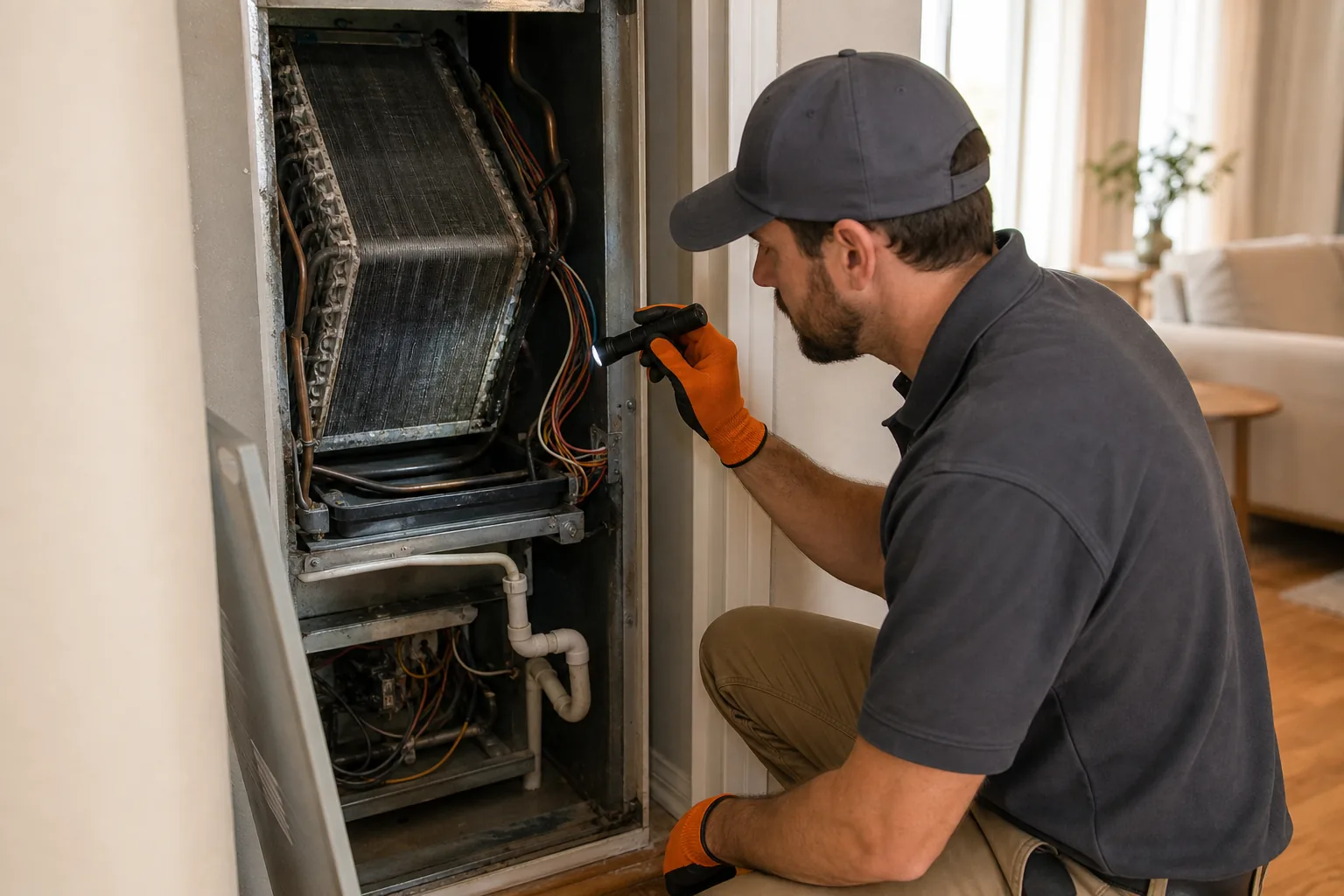
For help assessing a UV light installation in Auburn, Colfax, Rocklin, Roseville, Grass Valley, Penn Valley, or Lincoln, contact Home Worx Heating and Cooling.
Step 2: Choose the Right UV-C Light, Wavelength, and Placement
When you compare a UV light for HVAC system use, start with placement rather than the product name. A coil lamp usually belongs inside the air handler, aimed at the evaporator coil and drain pan. An in-duct unit belongs in a return or supply plenum only when its output matches the system's airflow.
The wavelength alone won't tell you if a lamp fits your system.
Power varies much more. Listed products range from 14 watts to 150 watts. A low-power residential unit may suit a small duct setup, while a higher-power unit may be aimed at a larger system. Wattage still isn't the same as delivered UV dose, so don't size by wattage alone.
Decision point | What to check | Why it matters | Warning sign |
Primary target | Coil and drain pan, or moving air | Stationary surfaces allow longer exposure | One lamp is promised to solve every air-quality issue |
Wavelength | About 253.7 to 254 nm for common UV-C lamps | Shows the lamp's germicidal band | No wavelength listed |
Power | Actual watt draw and voltage | Helps check electrical fit and operating cost | Only a vague “high output” claim |
Airflow | Required CFM or tested air speed | Moving air gets less exposure time | No airflow data at all |
Placement | Clear line of sight to the coil or duct stream | UV works only where light reaches | Bulb is blocked by metal or insulation |
Service | Access to the lamp and power shutoff | Annual checks must be safe and simple | Panel must stay open to reach the lamp |
A proposal should state the system's airflow, the lamp's intended application, and the reason for the selected location.
Placement near the coil often makes sense in a home because it targets the damp surface where biofilm can form. In-duct treatment is harder to size. If your goal is allergy relief, add a suitable filter instead of expecting UV to remove pollen.
For a home in Rocklin or Roseville, ask whether the lamp will run during cooling only or during blower operation. For a heat pump, ask how the lamp will interact with the air handler across both heating and cooling seasons.
Home Worx Heating and Cooling can review the cabinet, duct path, electrical supply, and access before recommending a setup. A written proposal should state the lamp's wavelength, wattage, voltage, mounting point, expected service interval, and any missing airflow rating.
Key Takeaway:Choose the application first. A properly placed coil lamp is often a better fit than an in-duct lamp with no published airflow basis.
Step 3: Install the UV Light Safely in the Air Handler or Duct
Installing a UV light for an HVAC system means working around electrical parts, moving air, sharp sheet metal, and equipment that may contain refrigerant or gas controls. The safe goal is a fixed mount with no direct UV exposure to people.
Turn off the HVAC system at the thermostat. Then shut off the equipment disconnect or breaker according to the installation instructions. Test that the blower and lamp circuit are off before opening the cabinet.
Don't rely on the thermostat alone. A service switch may be mounted near the furnace or air handler. A technician should identify every power source before touching wiring.
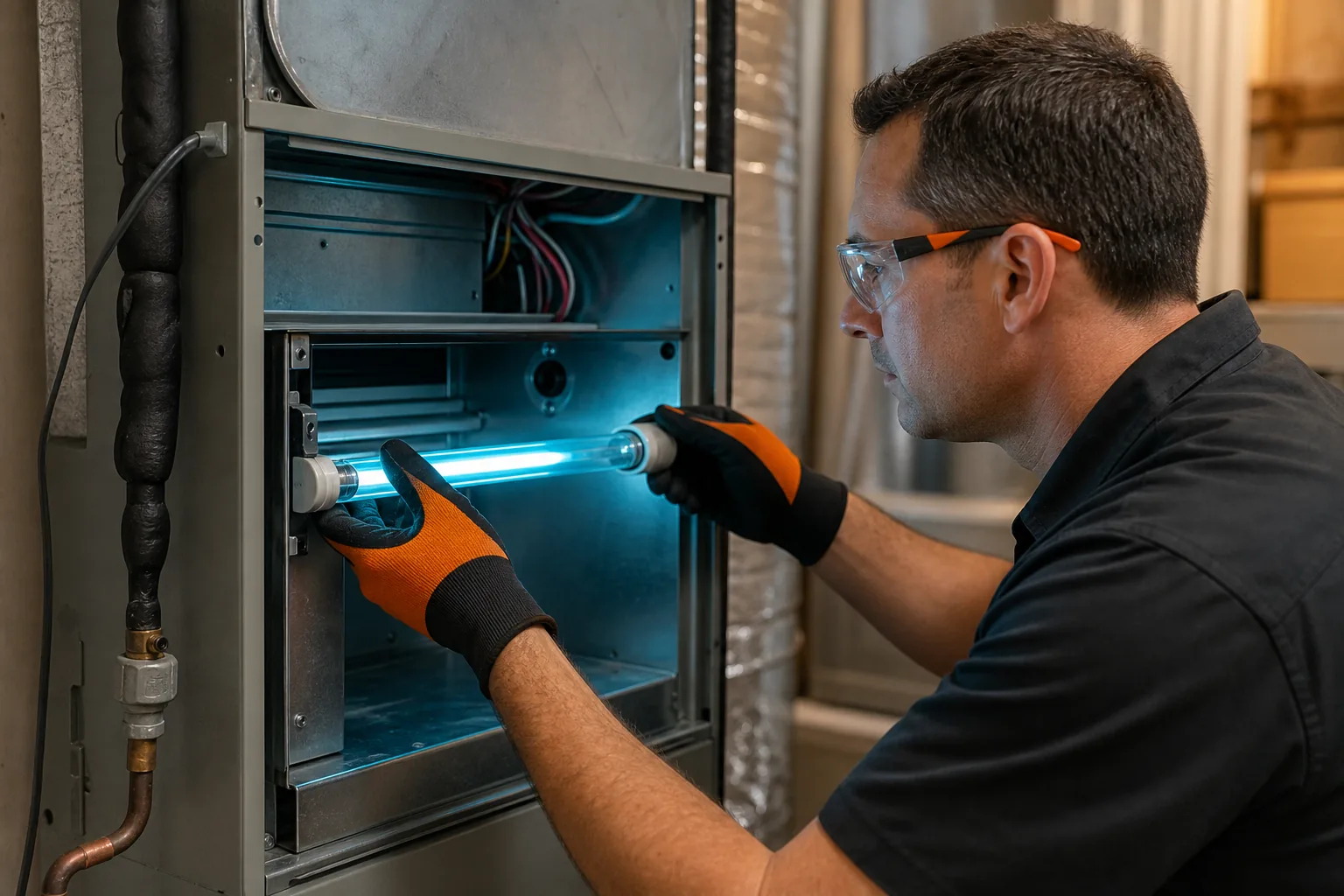
For a coil installation, the technician chooses a mounting point with a direct view of the coil face and drain pan. The bulb should not touch the coil. It also needs enough clearance for removal during service.
For an in-duct installation, the mount must seal the duct wall and keep the bulb secure when the blower starts. The lamp should not sit where dust, insulation fibers, or a damper blocks its light. The power supply needs strain relief and protection from condensation.
UV-C can damage some plastics, wire jackets, filters, and seals after long exposure. Keep the lamp away from materials that the manufacturer does not approve. A loose lamp can also vibrate against the cabinet and fail early.
The installation manual is the controlling document for the specific unit. A technical UV lamp installation manual should be kept with the equipment record so future service staff can confirm wiring, mounting, and safety steps.
California permit rules can vary by the local authority having jurisdiction. Ask the contractor to check the local rule before work begins.
The permit question matters more when the job changes ductwork, adds a new circuit, alters a commercial system, or forms part of a larger HVAC replacement. Local building departments may remain part of the review process.
After mounting the lamp, the technician should close the cabinet and confirm that no UV-C light escapes into occupied areas. The system should then run through a start-up check. Listen for vibration. Check the blower. Confirm that the lamp operates only under the intended control sequence.
Never look directly at a lit UV-C bulb. It can injure eyes and skin. If you need a lamp replaced, shut off power first and let a trained technician handle the work when access is tight or wiring is unclear.
Homeowners in Auburn, Colfax, and Rocklin should account for local installation conditions, while homes in Roseville, Grass Valley, Penn Valley, and Lincoln may also need a contractor to review the equipment and permit requirements.
For local UV light installation or service in Placer County and Nevada County, contact Home Worx Heating and Cooling.
Step 4: Operate, Inspect, and Replace the UV Lamp
Operating a UV light for an HVAC system is easy after installation, but maintenance cannot be skipped. A bulb may still glow after its germicidal output has dropped.
Set a service reminder for the interval in the manufacturer's instructions. Many residential UV-C lamps are replaced about once a year because output fades with use, even when the visible light remains. Some lamps have a longer rated life, so check the sleeve and equipment record instead of guessing.
At each inspection, shut off power before opening the air handler. Look for a darkened tube, cracked glass, loose mount, damaged wire, or moisture near the power supply. Don't touch the bulb with bare fingers if the instructions warn against it. Skin oil can leave a film on the glass.
Inspect the coil and drain pan too. A lamp that runs correctly should still be judged by the condition of the surface it treats. Heavy buildup, standing water, or a clogged drain may need cleaning before the lamp can do its job.
Make the replacement date easy to find. Write it on the service record, set a calendar reminder, or include it in a maintenance visit. Home Worx Heating and Cooling can pair a lamp check with routine HVAC service so the blower, filter, drain, and coil receive attention at the same time.
The lamp also adds a small electrical load. Research records show listed power from 14 watts to 150 watts, with many residential entries near the lower end. Ask for the actual wattage and voltage so you know what the unit will draw year-round.
Don't clean a lamp with a household spray. Follow the maker's cleaning directions. If the glass is broken, turn off power and keep people away from the area until the part is removed safely.
A replacement lamp must match the ballast, socket, voltage, and model requirements. Similar-looking tubes are not automatically safe substitutes. Bring the old lamp or equipment label to the service visit.
Step 5: Verify Results and Combine UV With Broader Air-Quality Measures
After installing a UV light for an HVAC system, verify the result against the problem you named in Step 1. A coil lamp should be judged by coil cleanliness, fewer musty odors, and steady drain operation. It should not be judged by a promise to remove every airborne particle.
Check the system after several weeks of normal operation. Look for recurring odor at start-up. Note whether the drain pan stays clear. Watch for changes in airflow, filter loading, or short cycling. These observations help separate a UV issue from a duct, moisture, or equipment fault.
UV works best as one layer. A filter captures particles that UV leaves behind. Moisture control limits the conditions that let mold grow. Regular coil and drain cleaning removes dirt that can shield microbes from the lamp.
For allergies, ask about the filter's MERV rating and the pressure drop it creates. A filter that is too restrictive for the blower can reduce airflow. The right choice depends on the cabinet, filter area, blower capacity, and system design.
For smoke, odors, or fine particles, a whole-house air purifier may fit better than a lamp alone. We can review the existing filter rack and duct pressure before adding equipment. That keeps the air-quality plan tied to the HVAC system instead of adding devices at random.
In Grass Valley and Penn Valley, seasonal dust and smoke can place extra demand on filters. In Lincoln, a duct inspection may matter if a home has long runs through an attic or other unconditioned space. A lamp cannot make up for a return leak that pulls in dirty air.
Use a simple handoff record with these details:
Lamp model and installation date.
Wavelength, wattage, and voltage.
Mounting point and control sequence.
Filter size and change schedule.
Next inspection and replacement date.
If you're comparing local service choices in Grass Valley, the Top 8 Reliable HVAC Companies in Grass Valley CA (2026) can help you frame questions about licensing, written scope, and maintenance support. We recommend asking every contractor to explain what the lamp will and won't treat.
Home Worx Heating and Cooling serves homeowners and small businesses across Placer and Nevada counties. We can assess the equipment in Rocklin, Roseville, Lincoln, Auburn, Colfax, Grass Valley, or Penn Valley and give you a clear next step.
FAQ: UV Light for HVAC System Installation and Care
Does a UV light improve indoor air quality?
A UV light can help limit mold and biofilm on damp HVAC surfaces, but it doesn't replace a filter. It also won't remove pollen, dust, or pet dander. A coil lamp is often aimed at the evaporator coil, while airstream treatment depends on dose and exposure time. Use filtration and moisture control for a broader air-quality plan.
Where should a UV light be installed in an HVAC system?
A UV light is often installed inside the air handler, aimed at the evaporator coil and drain pan. An in-duct lamp may go in a return or supply plenum, but it needs proper airflow sizing. The exact location depends on cabinet space, line of sight, wiring, service access, and the manufacturer's instructions.
How often should an HVAC UV lamp be replaced?
An HVAC UV lamp is commonly replaced about once a year, even if it still glows. Germicidal output can fade before visible light stops. Follow the lamp's rated interval when it differs. During replacement, inspect the mount, wire, glass, coil, and drain pan so a weak lamp doesn't hide a larger moisture problem.
Is DIY installation of a UV light in an HVAC system safe?
Professional installation is the safer choice because UV-C can injure eyes and skin, while the HVAC cabinet contains live electrical parts. A technician can also check placement, airflow, clearances, wiring, and local permit needs. Never open the cabinet with power on or leave a lamp where its light can reach occupied areas.
Will UV light remove pollen and pet dander?
UV light won't remove pollen or pet dander because those particles aren't living organisms. The particles can remain in the air after exposure. A properly sized filter is the better first step for allergies. If the home also has musty odors or coil growth, a coil lamp may complement the filter.
Conclusion
Choose UV based on the target, airflow, placement, and service plan, not wavelength alone. If you're in Auburn, Colfax, Rocklin, Roseville, Grass Valley, Penn Valley, or Lincoln, contact Home Worx Heating and Cooling for a local assessment and a written recommendation that fits your HVAC system.