
How Often to Change HVAC Filter: Simple Guide
Updated: Oct 4
A filter can look fine on the calendar and still be too dirty for your system. Most homes need a replacement every 1 to 3 months, but filter depth, pets, allergies, runtime, and local dust can change that fast.
For a typical Northern California home, Home Worx Heating and Cooling often recommends a six-month schedule as a starting point for deeper filters, with monthly checks. Use the steps below to set a schedule that fits your home.
Table of Contents
Step 1: Find Your HVAC Filter and Confirm Its Size
The first step in deciding how often to change your HVAC filter is finding every filter and reading the size printed on its frame. Most HVAC systems have one filter near the furnace or air handler, or behind a large return grille in a wall or ceiling. For homeowners in Auburn, Colfax, Rocklin, Roseville, Grass Valley, Penn Valley, and Lincoln, hot dry summers and cold winters can change system runtime; contact Home Worx Heating and Cooling for local service.
Some homes have more than one return filter. Walk through the house and check each return grille before you buy replacements. A multi-zone system may have a separate filter for each air handler.
Write down three details:
The length and width.
The thickness, such as 1 inch or 4 inches.
The MERV rating , if one is shown.
The size printed on the filter is usually the nominal size. The true filter may measure slightly less. That is normal. Buy the size printed on the old filter unless the system label or an HVAC technician tells you otherwise.
Never force a filter that is too large. Do not trim one that is too small. Gaps let dust pass around the filter, while a crushed filter can block airflow. The arrow on the frame also matters. It should point toward the furnace, air handler, or blower, in the direction air moves.
Trane explains that filters protect both indoor air and the equipment from dust, hair, and other particles. Its guidance also warns that a clogged filter can make the system work harder and may contribute to breakdowns. You can review Trane's explanation of HVAC filter size and airflow direction if you're unsure what the markings mean.
If you want a second check before installing a replacement, our guide to furnace filter direction covers the arrow and fit in plain terms.
Key Takeaway:Find every filter, copy the exact size from the frame, and confirm the airflow arrow before setting a change schedule.
Step 2: Match the Change Interval to Filter Thickness and Household Conditions
The best answer to how often to change an HVAC filter starts with thickness, then adjusts for how your home actually runs. A thin filter has less material to hold dust. A deeper media filter has more surface area and can usually last longer.
Use this table as a starting point, not a promise. Check the filter each month during heavy heating or cooling use.
Filter or home condition | Starting interval | Shorten the interval when |
1-inch filters | About 1 month | Usage, pets, or allergies call for more frequent changes |
Disposable HVAC air filter | About 1 month | Pollen season or heavy HVAC usage is present |
2-inch filter | About 2 months | Pet hair or heavy use loads the pleats early |
4-inch+ filters | About 3 months | Household environment or usage calls for earlier replacement |
Deep media filters | About 6 months | Household environment or usage calls for earlier replacement |
A basic 1-inch filter is often the most demanding case. Several source recommendations place that type on a monthly schedule, especially when pets or allergies are involved. A single short-haired pet may fit a two-month schedule in a clean home. Multiple heavy-shedding pets can push the schedule back to 30 days.
Homeowners with asthma or strong allergies should inspect the filter monthly during peak use. A higher MERV rating may capture more small particles, but it can also add airflow resistance. Check the equipment maker's guidance before moving to a much higher rating.
Our six-month recommendation from Home Worx Heating and Cooling is aimed at typical Northern California homes using a suitable deeper filter. It is not a reason to ignore the filter for six months. In a Roseville home with a dog and long summer runtime, a monthly or two-month change may make more sense. A lightly used Penn Valley vacation home may go longer, but it still needs an inspection before heavy seasonal use.
Follow the filter maker's directions and replace the filter when it becomes dirty. Filter choice and maintenance affect system airflow and efficiency; see the guide to air cleaners in the home for general information.
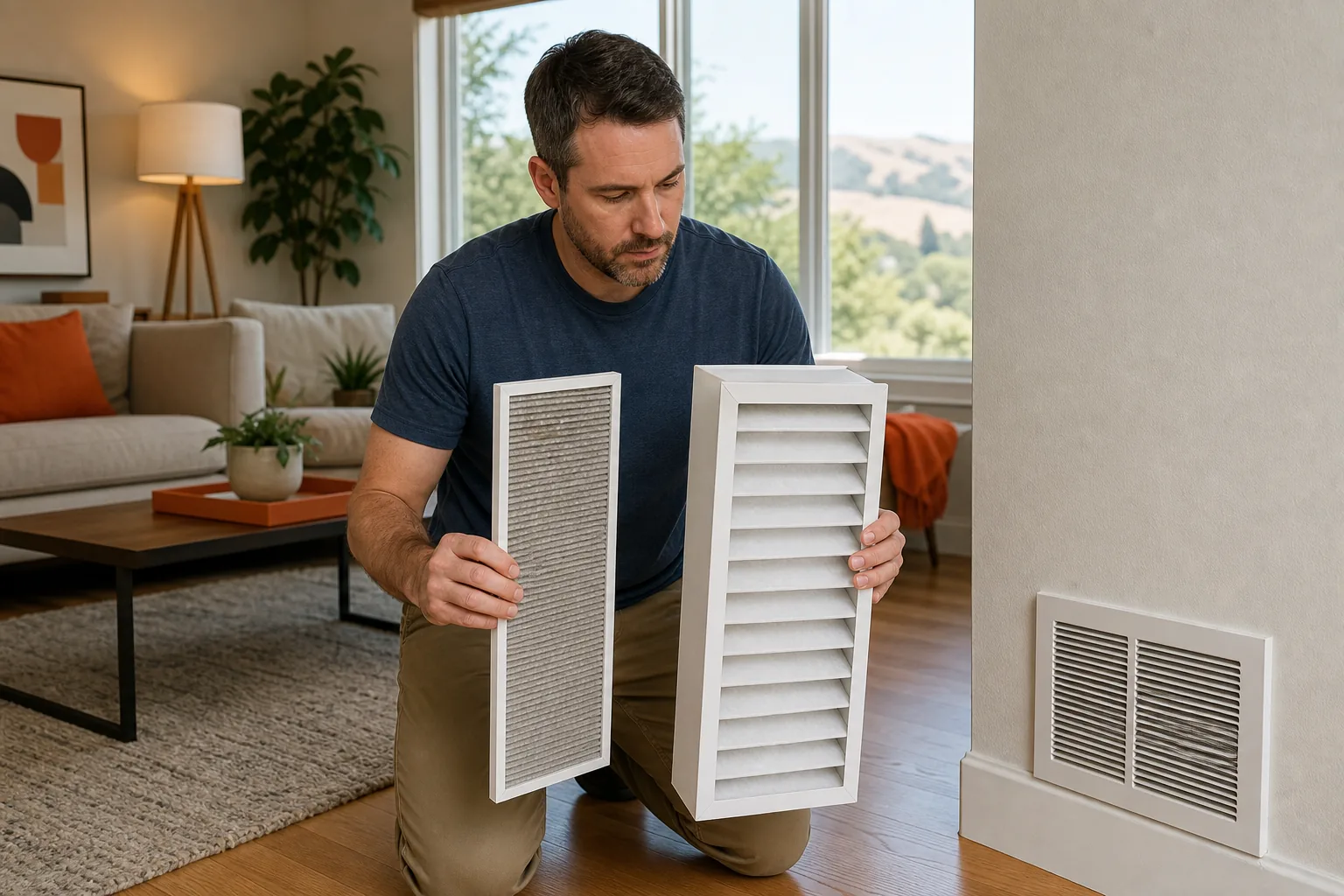
Seasonal weather changes matter here. Hot, dry summers can mean long cooling cycles and more outdoor dust in Auburn, Rocklin, and Lincoln. Cold winters in Colfax, Grass Valley, and nearby foothill towns can bring long heating cycles. Check at the start of each season, then adjust based on what you see.
Pro Tip:Write the installation date on the filter frame. Check it after 30 days. If it is already gray or matted, set your next reminder sooner.
For local filter guidance in Auburn, Colfax, Rocklin, Roseville, Grass Valley, Penn Valley, or Lincoln, contact Home Worx Heating and Cooling.
Step 3: Remove and Replace the HVAC Filter Safely
Replacing a filter should take only a few minutes, but the order matters. Turn the HVAC system off at the thermostat before opening the filter slot. This stops the blower while you work and keeps the system from pulling unfiltered air through the opening.
Put the new filter beside the old one before removing anything. Confirm the width, height, thickness, and MERV rating. If the old filter is bent or packed with debris, take a photo of its position before pulling it out.
Turn off heating and cooling at the thermostat.
Open the return grille or filter cabinet.
Slide out the old filter without shaking it.
Check the new filter's size and airflow arrow.
Point the arrow toward the blower or air handler.
Slide the filter in until it sits flat and snug.
Close the grille or cabinet, then turn the system back on.
The filter should not bow, fold, or leave a wide gap. If it will not slide in easily, stop. A wrong size may damage the frame or leave an opening that lets dust bypass the filter.
Do not assume a washable filter belongs in every system. Some equipment uses washable screens, while other equipment uses disposable filters. Follow the label for your equipment. If the filter slot is hard to reach or the cabinet is damaged, have a technician check it.
After the system starts, listen for odd rattles and check airflow at the nearest supply vent. A filter change will not fix a weak blower, a blocked duct, or a frozen coil. It can, however, remove one common cause of restricted airflow.
Home Worx Heating and Cooling can help if you cannot find the filter, have several filter locations, or keep seeing the filter collapse. The issue may be the cabinet, the filter size, or the system's airflow design rather than the replacement itself. Service is available for homeowners in Auburn, Colfax, Rocklin, Roseville, Grass Valley, Penn Valley and Lincoln.
Step 4: Shorten the Schedule When Local Conditions or Warning Signs Demand It
Calendar dates are useful, but visible dirt and system behavior give a better answer to how often to change an HVAC filter. Inspect the filter sooner after a heat wave, cold snap, home renovation, or period of heavy dust.
Shorten the interval when your home has:
One or more shedding pets.
Asthma or allergy concerns.
Construction dust or indoor smoking.
High occupancy or long daily system runtime.
Wildfire smoke or unusually poor outdoor air.
Look for a gray, matted surface. Pet hair along the edges is another clear sign. You may also notice weaker airflow, rooms that take longer to reach the set temperature, more dust after cleaning, or longer system run times.
A dirty filter can restrict airflow across the indoor coil. In cooling season, that restriction may contribute to a frozen coil. In heating season, it can make the furnace run hot and cycle off on a safety limit. Turn the system off and replace the filter if you see ice, smell burning, or hear repeated short cycling. Do not keep resetting the system and hope the issue clears.
Local conditions can shift the schedule from one street to the next. A dusty property near open land in Lincoln may load a filter faster than a sealed home in Rocklin. A home in Auburn with several pets may need monthly checks even with a deeper filter. In Penn Valley, a part-time home may need a fresh filter before each long stay.
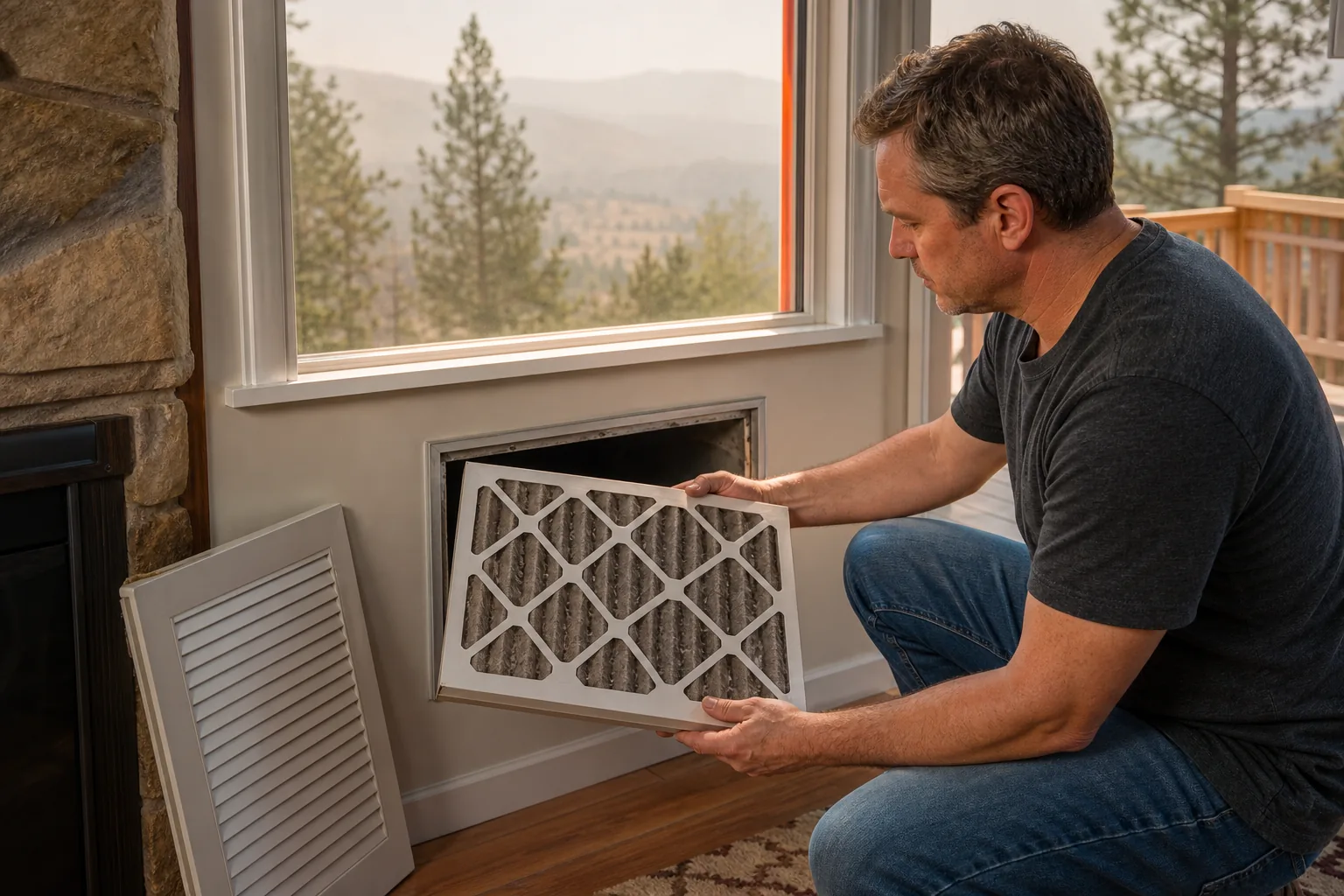
Inspect after local smoke events, even if the filter is fairly new. Fine particles can load filter media quickly. Also inspect after work that creates dust, such as sanding, drywall repair, or floor replacement. Covering returns during dusty work helps, but it does not replace a later inspection.
For more help with dust inside the home, our guide to reducing household dust explains where HVAC filtration fits with the rest of your cleaning plan.
When in doubt, replace early. A slightly early change costs less than running a system against a badly blocked filter.
Step 5: Set a Reminder and Know When to Call an HVAC Professional
The final step is turning a one-time change into a repeatable habit. Set a calendar reminder for 30 days after installation, even if you expect the filter to last longer. Use that date to inspect it, not automatically replace it.
After two inspection cycles, set the replacement reminder around what your home shows. If the filter is dirty at 30 days, stay on a monthly schedule. If it remains fairly clean, check again at 60 days. A deeper filter may support a longer interval, but follow its label and the system maker's instructions.
Restart the test whenever conditions change. A new pet, a remodel, a move, a new filter rating, or a smoky season can change the result. Keep at least one spare filter in the home, but store it in a dry place where it will not bend.
Filter changes do not replace yearly system care. A technician can inspect the blower, coil, wiring, duct connections, refrigerant system, and safety controls. That matters if the system has a history of poor airflow or repeated shutdowns.
Contact Home Worx Heating and Cooling when a new filter does not improve airflow, the system freezes, the furnace shuts off repeatedly, or you smell burning. We serve homeowners and small businesses in Auburn, Colfax, Rocklin, Roseville, Grass Valley, Penn Valley, and Lincoln. Our team can check the filter setup and look for the fault behind the symptom.
For a wider maintenance plan, to how often an HVAC system should be serviced . Filter care is one task. It cannot diagnose every problem inside the equipment.
Key Takeaway:Inspect monthly, change sooner when the filter is dirty, and arrange service when airflow or cycling problems continue after replacement.
FAQ
How often should I change my HVAC filter?
Many residential HVAC filters need replacement on a schedule based on filter size and household conditions. A 1-inch filter may need monthly replacement when usage, pets, or allergies are factors, while a deep media filter may last six months depending on the household environment and usage. Check it monthly and shorten the schedule for heavy system use. Homeowners in Auburn and Colfax can use this inspection routine year-round.
Can an HVAC filter last six months?
Yes, a deep media filter may last six months depending on the household environment and system usage. Inspect it monthly, because pets, dust, and long summer or winter run times can cut that interval. This is a useful check for homes in Rocklin and Roseville.
How often should I change a standard 1-inch filter?
A standard 1-inch filter may be changed every three months, with monthly replacement when usage, allergies, or pets are factors. Look at the filter after 30 days. If the surface is gray, matted, or covered with hair, replace it then. Homeowners in Grass Valley and Penn Valley can use the filter's condition to adjust the schedule.
What happens if I do not change my HVAC filter?
A neglected filter restricts airflow and makes the system work harder. You may notice weak airflow, longer run times, higher energy use, dust, or uneven comfort. Continued restriction can contribute to a frozen cooling coil or furnace safety shutdown. Replace the filter and arrange service if the symptoms remain, including in Lincoln homes.
Should I change my filter before wildfire smoke reaches my area?
Yes, inspect the filter before and after a smoke event. Fine particles can load filter media faster than normal dust. Replace it if it looks gray or clogged, even when it is newer than your usual schedule. Also check the filter after nearby construction or other work that creates heavy dust.
For local filter guidance, contact Home Worx Heating and Cooling for service in Auburn, Colfax, Rocklin, Roseville, Grass Valley, Penn Valley, and Lincoln.
Conclusion
Start with a monthly inspection. Most homes will land on a 1-to-3-month replacement cycle, while deeper filters may run longer under light use. Write the date on the frame and contact Home Worx Heating and Cooling for local help in Placer or Nevada County if airflow, freezing, or repeated shutdowns continue after a fresh filter is installed.