
How to Replace an HVAC Air Filter
A clogged filter can make your HVAC system work harder, but a fresh one usually takes just a few minutes to install. If you’re learning how to replace an HVAC air filter, use these five steps to find the right filter, fit it safely, and keep track of when to check it again.
We analyzed 53 YouTube comments about HVAC air filter replacements and found that 45% mentioned installing the filter backwards.
Table of Contents
Step 1: Locate the Filter and Confirm the Right Size
First, find every filter your system uses. In a central heating and cooling system, it may sit behind a large return grille on a wall or ceiling. It may also slide into a slot on the furnace or air handler, the indoor unit that moves air through the ducts.
Check the utility closet, garage, attic, or other area where the indoor unit sits. Look for a filter access slot near the large return duct. If the system has more than one return grille, check whether each one holds a filter. Don’t pry open a sealed equipment panel to search. Use the owner’s manual if the location isn’t clear.
Common filter locations include a frame on the unit, a nearby compartment, or a return grille. Once you find the filter, write down the length, width, and thickness printed on its frame. If there’s no label, measure the old filter or the slot and match the result to the filter maker’s sizing guidance.
Buy the same labeled size and thickness unless the equipment manual or an HVAC professional recommends a change. A filter that’s too small can leave gaps. One that’s too large may bend or refuse to slide in. Also note the MERV rating, a scale used to describe how well a filter catches particles. A higher rating can capture smaller particles, but it may also restrict airflow if the system isn’t built for it. Check the system instructions before changing ratings.
Save the size and rating in a phone note, along with a photo of the filter label. That small record can save a second trip to the store. If you have a ductless mini-split, check its manual: many models have reusable filters that need cleaning rather than replacement. A portable AC unit may use a different filter setup, so follow that unit’s own instructions.
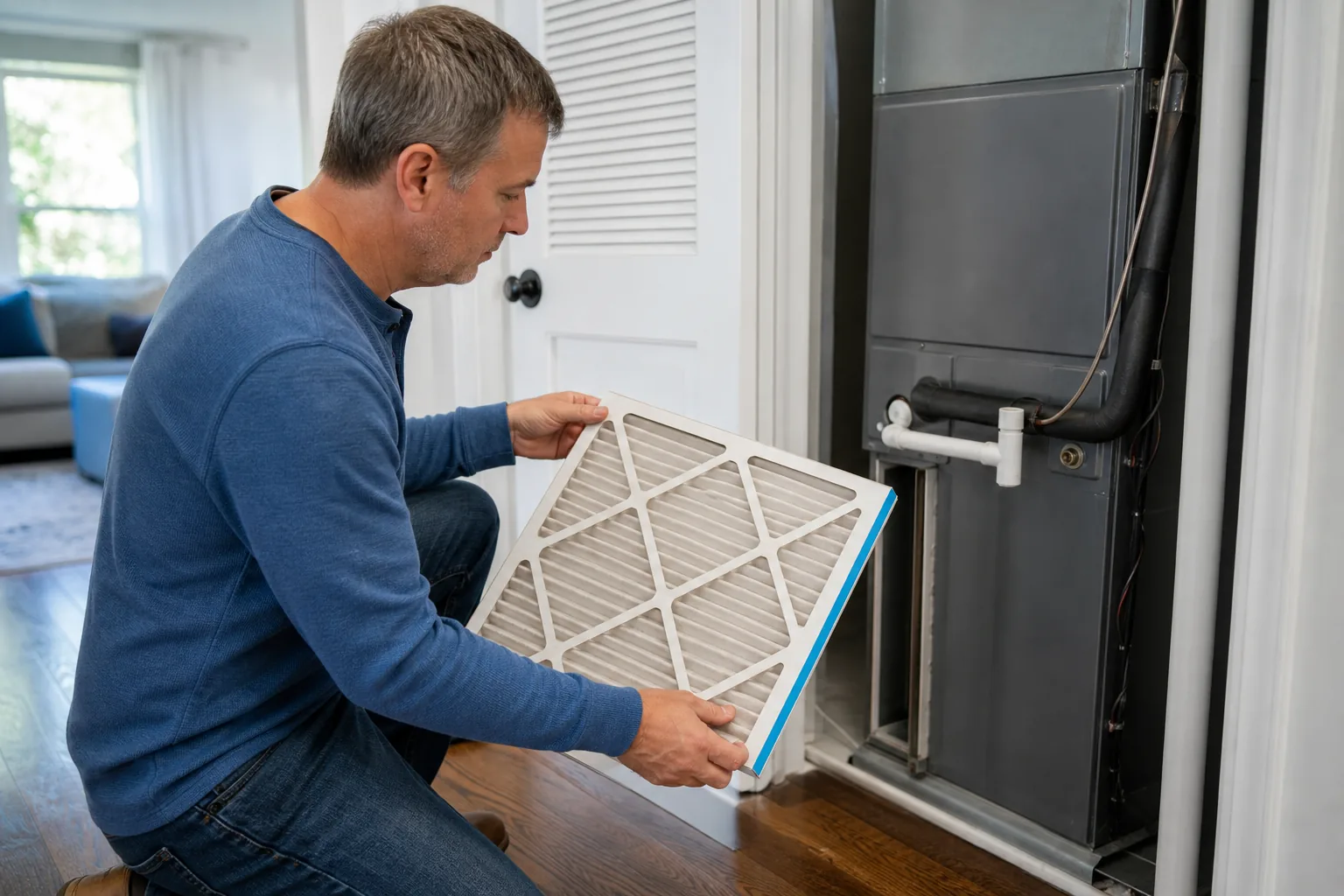
Hot, dry summers and cold winters can mean long heating or cooling runs for homeowners in Auburn, Colfax, Rocklin, Roseville, Grass Valley, Penn Valley and Lincoln. Note the filter size before the busy season, not after airflow drops. For local help, contact Home Worx Heating and Cooling .
Step 2: Turn Off the System and Remove the Old Filter
Stop the blower before opening the filter slot. Set the thermostat to Off, then wait until you can no longer hear or feel the system running. This keeps the system from pulling air through the open slot while you work.
If you need to reach inside the air handler or remove an access cover, follow the equipment manual’s power-off directions . Don’t touch wiring or internal components. If the task involves more than the filter slot, stop and get help from an HVAC technician.
Open the grille or filter slot as designed. Depending on the setup, a cover may use clips, tabs, thumb screws, or a sliding door. Remove only the cover for the filter access. If screws are present, use the right screwdriver and keep the screws together so they don’t fall into the equipment.
Slide the old filter out slowly. Hold it level to limit the dust that falls off, and note which way its arrow points before you set it aside. If dust bothers you, place the used filter straight into a bag. Don’t shake it indoors.
Take a quick look at the slot and the grille. If you see loose dust on the accessible surfaces, remove it with a vacuum or dry cloth. Keep the cleaning tool out of the equipment cabinet, and don’t use water or spray cleaner inside the unit. Check that the filter track and cover look intact. If the slot is bent or the cover won’t close, don’t force the new filter into place.
Now compare the old filter’s size and thickness with the replacement. If they don’t match, pause before installing it. A few minutes spent checking now can prevent a loose fit or a filter that blocks the opening.
Step 3: Install the New Filter With the Airflow Arrow Pointing the Right Way
The arrow on the filter frame shows the direction air should move through it. In most central systems, that means the arrow points toward the furnace, air handler, or blower, away from the return grille. Air enters from the return side, passes through the filter, then reaches the equipment.
Before sliding the filter in, find the arrow on its cardboard frame. If you took the old filter out carefully, its position can help confirm the direction. But use the airflow path and the system instructions to check, rather than copying a filter that may have been installed backward.
Push the new filter into the slot with the arrow pointing toward the equipment. It should slide in without bending. Check that the frame sits flat and covers the opening. A filter that bows, rattles, or leaves a clear gap may be the wrong size or may not be seated properly. Don’t trim the frame or wedge in a filter that doesn’t fit.
For a return grille, the arrow usually points into the duct, away from the room. For a filter mounted at the air handler, the arrow points into the unit. The exact direction depends on where the filter sits in the airflow path. If you want a visual explanation of common setups, see our guide to furnace filter direction and arrow placement .
Check the filter type, too. A disposable filter belongs in the trash after use, not under a tap. A washable filter is different: clean it only as the manufacturer directs, then let it dry fully before putting it back. A wet reusable filter can cause trouble for the system.
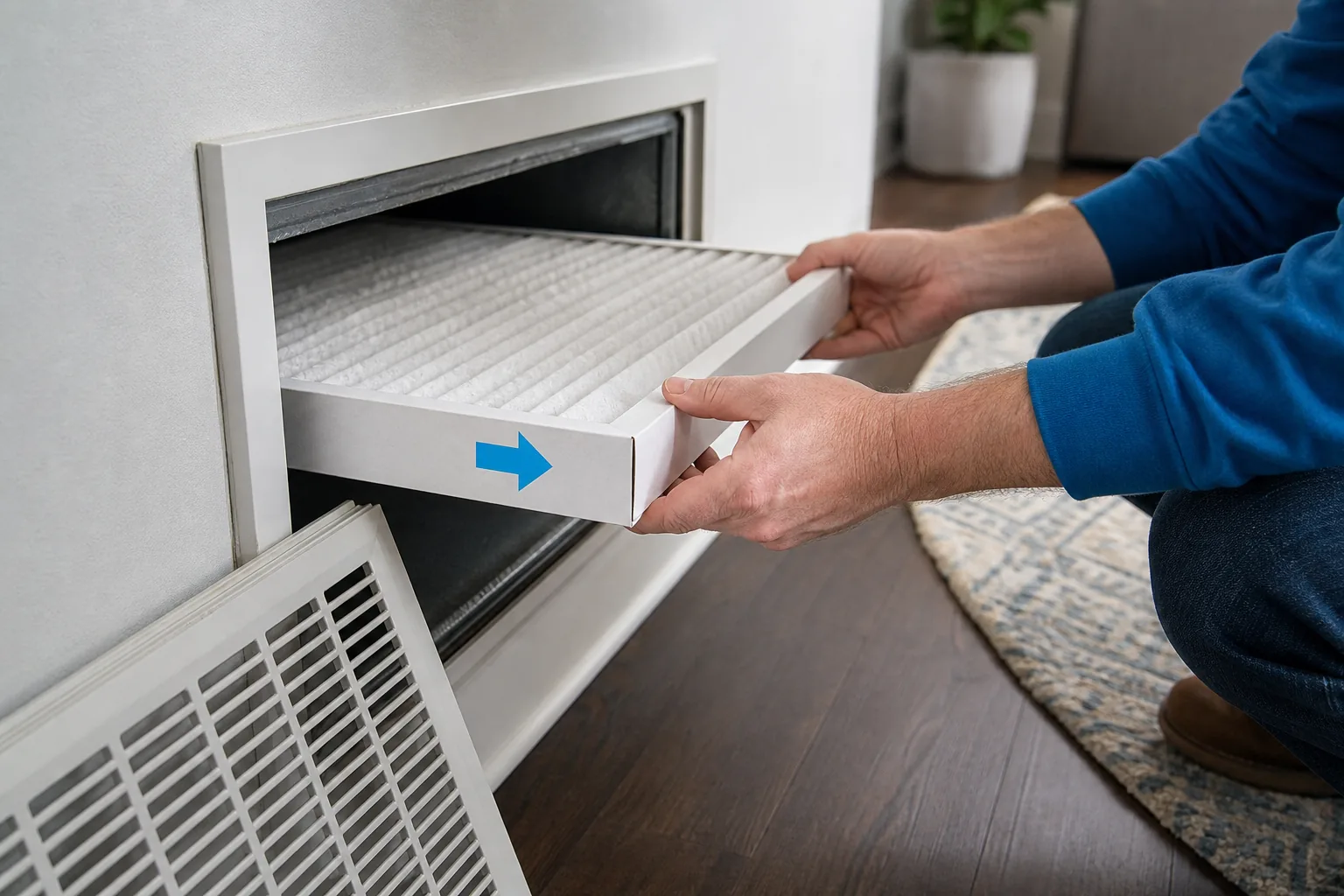
Close the grille or filter access cover once the filter sits in place. If the cover won’t close normally, take the filter back out and check its size and position.
Step 4: Restart the HVAC System and Check Its Operation
Once the filter is seated and the cover is secure, set the thermostat back to its usual mode and temperature. If you turned off a breaker for access, restore it only after the cover is closed and the system is ready to run. Follow the equipment instructions if they give a different restart process.
Listen as the system starts. A normal start should not include a new rattle from the filter area. Walk to a nearby supply vent, the opening that sends conditioned air into a room, and check for steady airflow. The filter itself shouldn’t shift or flap.
If airflow feels weaker than before, turn the system off and recheck the filter. Make sure the arrow points toward the equipment and that the filter isn’t folded, bowed, or blocking the slot. A filter with a higher MERV rating can add airflow resistance, so don’t assume a higher number is right for every system.
Also watch for problems that were present before the change. A new filter may help if a dirty one was restricting airflow, but it won’t fix a blocked duct, a faulty blower, or another equipment issue. If the system won’t start, the breaker trips, or a new noise continues after you check the fit, stop troubleshooting and arrange service.
A fresh filter helps protect the system from dust and supports airflow, but it is only one part of maintenance. If your system still runs poorly after a correct filter change, a technician can inspect the equipment and look for the cause instead of having you keep swapping filters.
Home Worx Heating and Cooling is a family-owned HVAC contractor serving Placer and Nevada counties. We provide HVAC repair and maintenance for homes in Rocklin and Roseville, as well as nearby foothill communities.
Step 5: Record the Change and Set a Practical Replacement Schedule
Write the installation date on the filter frame if there’s a clear spot, then add the date and size to your phone calendar or notes. Set a reminder to inspect it. The reminder is a prompt to check, not a rule that says every filter must be replaced on that exact day.
For a standard one-inch disposable filter, a common starting point is to inspect it monthly and replace it as needed. Many filters need changing every one to three months, but the right interval depends on the filter and how the home is used.
Start by checking the filter once a month. Hold it toward a light or look for a gray layer of dust, visible debris, or airflow that has weakened. If it looks loaded, replace it even if the calendar reminder is still weeks away. If it stays fairly clean, keep checking and adjust the reminder based on what you see.
Use the same approach as the foothill weather changes. Hot, dry summer days can keep cooling equipment running for long periods. Cold winter stretches can do the same for heating. Dust, pets, indoor smoke, nearby construction, or open windows during a smoky period may also mean the filter needs attention sooner.
After two or three inspections, you’ll have a better sense of how quickly your filter loads in your home. Keep a spare filter of the correct size on hand if you can. That way, you won’t have to delay a change because the right one isn’t available.
For a fuller schedule based on filter depth, pets, allergies, and system use, our guide to HVAC filter replacement timing can help you set a reminder that fits your household. A smart thermostat or HVAC app may also provide a filter reminder, but treat it as a prompt to inspect the filter. Use its condition and the equipment maker’s instructions to decide when to change it.
For disposal, seal a dusty disposable filter in a bag before putting it in household trash. Don’t assume the filter media can go in curbside recycling. Check your local waste program for current rules. Reusable filters should be cleaned and stored only as the manufacturer directs.
Home Worx Heating and Cooling serves Grass Valley, Penn Valley, and Lincoln, along with nearby areas. If you’d rather have a technician check the system during routine maintenance, our team can help you plan service for your home.
FAQ
How long does it take to replace an HVAC air filter?
Replacing a standard HVAC filter usually takes about five minutes. The time depends on where the filter sits and whether the access cover is easy to open. Turn off the system first, confirm the replacement size, then check the arrow and fit before restarting. If the slot is hard to reach, don’t force access.
Which way should the arrow point on an HVAC filter?
The airflow arrow should point toward the furnace, air handler, or blower. At a return grille, that usually means the arrow points into the duct, away from the room. The arrow follows the direction air moves through the system. If you’re unsure, check the equipment manual or ask an HVAC technician.
Can I use a higher MERV filter in my HVAC system?
Use a higher-MERV filter only if your system can handle it. MERV describes how well a filter captures particles, and higher ratings can also create more resistance to airflow. Check the system manual before changing ratings. If the recommended filter type isn’t clear, ask an HVAC professional to confirm a safe match.
Can I wash and reuse my HVAC filter?
Wash a filter only if it’s designed to be reusable. Many central HVAC filters are disposable, and washing them can damage the material. Some ductless mini-split systems use washable filters, but their care steps can vary. Follow the instructions for your specific system, and let a washable filter dry fully before reinstalling it.
Conclusion
Use the filter size and type your system calls for, and make the arrow point toward the equipment. Set a monthly reminder to inspect it, then change it when it’s dirty or due under the manufacturer’s guidance. If you’d like help with local HVAC maintenance, contact Home Worx Heating and Cooling to arrange service.