
Swamp Cooler vs Air Conditioner: Which Wins?
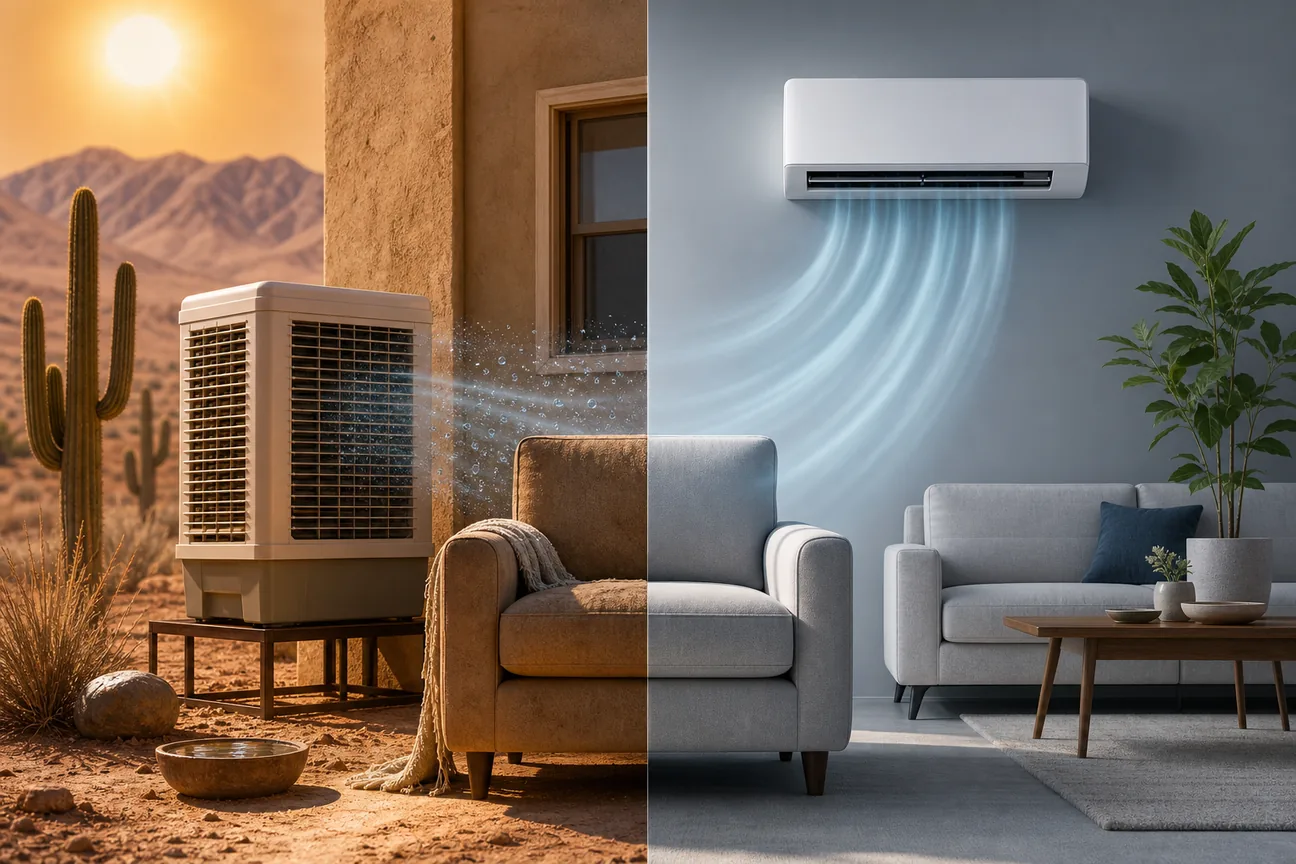
Can a swamp cooler really keep up with a full air conditioner in the Sierra foothills? For Placer and Nevada County homeowners, the answer depends on humidity, budget, and how much maintenance you're willing to handle. Here's a straight comparison of every key factor so you can pick the right system before summer heat peaks.
Table of Contents
2. Ideal Climate and Humidity Conditions — Dry Heat vs. Humid Air
3. Upfront Cost and Installation Requirements — What You'll Actually Pay
4. Energy Efficiency and Operating Costs — Monthly Bills Compared
5. Comfort, Air Quality, and Health Effects — Humidity, Mold, and Freshness
6. Maintenance Needs — Pads, Filters, Refrigerant, and Winterizing
7. Noise, Safety, Water Use, and Lifespan — The Details That Matter
8. DIY Hacks and Budget Alternatives — When Neither Is Quite Right Yet
1. Home Worx Heating and Cooling (Our Top Pick)
Home Worx Heating and Cooling is a family-owned HVAC contractor based in Colfax, CA, serving Placer and Nevada County communities including Auburn, Rocklin, Roseville, Lincoln, Grass Valley, and Penn Valley. They install refrigerant-based central AC and ductless mini-split systems with 24/7 emergency support and flexible financing.
For homeowners in the Sierra foothills, a refrigerant system from Home Worx is the better long-term bet. Summers here routinely hit 100°F, and afternoon humidity can spike enough to shut down evaporative cooling entirely. A properly sized central AC unit handles those conditions without skipping a beat.
Home Worx pairs their AC installations with a standard annual service contract, which is a real advantage over swamp coolers that need pad replacements every season. If you're weighing all your options, the heat pump vs air conditioner comparison on the Home Worx blog is worth reading before you decide on equipment type.
The honest caveat: refrigerant systems cost more upfront. A new central AC installation in Placer County typically runs $8,000 to $15,000 depending on home size and equipment. But for a home you plan to live in for years, that cost spreads out quickly when you factor in reliability and comfort on the worst heat days.
Key Takeaway:For most Northern California homes above the valley floor, a refrigerant system from a local contractor like Home Worx delivers consistent cooling that a swamp cooler simply can't match once summer humidity climbs.
2. Ideal Climate and Humidity Conditions — Dry Heat vs. Humid Air
This is the single biggest factor in the swamp cooler vs air conditioner decision. Evaporative coolers work on one principle: dry air absorbs water vapor, and that phase change pulls heat out of the air. When the outdoor air is already humid, that process slows to almost nothing.
The usable cutoff is around 60% relative humidity. Below that, a swamp cooler can drop air temperature meaningfully. Above it, you're mostly running a fan that adds moisture to an already sticky room. The wet-bulb temperature sets the absolute floor for cooling — no matter how good the unit is, it cannot cool air below that threshold.
In the Sierra foothills, humidity is low most of May and June. But July and August bring afternoon thunderstorm patterns that push relative humidity above 50% on many days. That's exactly when you need cooling most, and it's exactly when a swamp cooler loses its edge.
Air conditioners don't care about outdoor humidity. They remove moisture from indoor air as part of the refrigeration cycle, which is why they feel so much more comfortable on muggy days. If you live at lower elevations near Sacramento, summer humidity is even more of a factor.
3. Upfront Cost and Installation Requirements — What You'll Actually Pay
The price gap between these two systems is real, but it's smaller than most people expect once you look at the full range.
Swamp cooler installation costs vary a lot by type. A basic window-mount unit runs $300 to $800 installed. A single-stage rooftop evaporative cooler costs $1,500 to $3,500. A two-stage indirect/direct hybrid , the most capable evaporative option , can reach $4,000 to $8,000. That top end overlaps directly with the low end of central AC.
On the AC side, a ductless mini-split system runs $2,500 to $15,000 depending on the number of zones. Full central AC with new ductwork in a home that doesn't already have it lands between $8,000 and $16,000. For homes in Rocklin or Auburn that already have duct systems, the cost is lower because the infrastructure is already there. You can see a general breakdown of HVAC installation pricing for Rocklin-area homes on the Home Worx service page.
Labor rates for swamp cooler installation run $50 to $70 per hour, with most ground-mount or roof-mount jobs taking five to ten hours. If your home needs new ductwork added, that can add meaningfully to the total cost. The idea that swamp coolers are always the cheap option breaks down fast when you're looking at a whole-house setup.
Pro Tip:California and PG&E offer rebates on high-efficiency AC systems that can meaningfully offset installation costs. Check current 2026 state and utility programs before you buy , a qualifying system can bring your net cost down by hundreds to several thousand dollars.
4. Energy Efficiency and Operating Costs — Monthly Bills Compared
Factor | Swamp Cooler | Central / Ductless AC |
Typical power draw | 150–350 watts | Significantly higher than evaporative coolers |
Est. monthly running cost | ~$6–$15 | ~$52–$65 |
Works in high humidity? | No (above 60% RH) | Yes, any humidity |
Energy use vs traditional AC | 15–35% less | Baseline |
Uses refrigerant? | No | Yes |
SEER rating range | — | 13–21+ |
The monthly operating cost difference is significant. A swamp cooler running 8 hours a day at 250 watts costs roughly $10 a month in electricity. A 12,000 BTU air conditioner at the same usage runs closer to $55 to $65 a month. That's a real gap.
But here's what the simple comparison misses: if your swamp cooler can't cool the house on the hottest, most humid days, you end up miserable or buying a portable AC anyway. The energy savings disappear when the unit stops working effectively. For homes in the foothills where summer afternoons regularly push past 100°F and humidity spikes, an AC's higher operating cost buys something a swamp cooler can't: consistent performance every single day.
Water use is another real cost for swamp coolers, especially in drought years. A whole-house evaporative cooler can use 3 to 15 gallons of water per hour depending on size. In areas with water restrictions or high water rates, that adds up across a long California summer.
5. Comfort, Air Quality, and Health Effects — Humidity, Mold, and Freshness
Swamp coolers pull 100% fresh outdoor air into your home and push stale air out through open windows. On a dry day, that constant air exchange feels genuinely pleasant , similar to a natural breeze. It also means you can't seal the house up, which matters for security and for keeping wildfire smoke out during fire season.
Air conditioners recirculate indoor air through a filter. For allergy and asthma sufferers, that filtration is a real benefit. The system removes pollen, dust, and particulates from the air on each pass. Home Worx installs AC units with quality air filtration, helping maintain indoor air quality without the homeowner having to track filter replacement schedules.
Mold is a legitimate concern with swamp coolers. The cooling pads stay wet during operation, and if indoor humidity climbs above 65% consistently, porous surfaces in the home can develop mold. This risk is highest when the outdoor air is already humid , exactly the conditions where swamp coolers lose their effectiveness anyway. Proper maintenance (draining the reservoir weekly, replacing pads each season) reduces the risk, but it doesn't eliminate it.
Air conditioners dehumidify as they cool, keeping indoor relative humidity in a comfortable 40, 55% range. That's better for wood floors, furniture, and respiratory health. It also means no open-window requirement, so you keep wildfire smoke, allergens, and insects outside where they belong.
6. Maintenance Needs — Pads, Filters, Refrigerant, and Winterizing
Swamp coolers need more hands-on attention than most homeowners expect. At the start of each season, the cooling pads need inspection and likely replacement. Aspen fiber pads typically last one season. Rigid cellulose honeycomb pads last three to five years but cost more upfront. The pump screen needs cleaning, the float valve needs checking, and the reservoir needs weekly draining during active use to prevent mineral buildup and biological growth.
At the end of the season, the unit needs to be winterized: drain the reservoir completely, remove or cover the pads, and cover the exterior. Skip any of these steps and you're looking at rust, scale buildup, or a failed pump come spring. A professional maintenance plan for a swamp cooler runs around $129 per year for pad replacement and a pump check, and that's on top of any repair costs if something fails.
Common swamp cooler repairs run $115 to $350 on average. Pump and motor replacements add to that cost when components fail. These aren't rare events — mineral-heavy water in the Sierra foothills accelerates wear on pumps and pads faster than in softer-water regions.
A well-maintained central AC system needs an annual tune-up and filter changes every one to three months. Refrigerant doesn't need topping off unless there's a leak, and a properly installed system can run 15 to 20 years without major repairs. The maintenance burden is lower, and the work is more predictable. If you want to understand what AC repair costs look like when something does go wrong, the Home Worx guide on AC not blowing cold air walks through the most common issues and what to check first.
7. Noise, Safety, Water Use, and Lifespan — The Details That Matter
Swamp coolers are quieter. They run a fan and a small pump , no compressor. A quality portable evaporative cooler operates at 50 to 60 decibels, roughly library-level noise. Air conditioners add compressor noise on top of the fan, typically 55 to 65 decibels for modern outdoor units. Inside the house the difference is subtle, but it's real, especially at night.
Safety is a bigger issue with roof-mounted swamp coolers than most people discuss. Accessing a rooftop unit for seasonal maintenance means climbing up twice a year, every year. Falls from residential roofs are a leading cause of home maintenance injuries. Ground-mounted evaporative coolers are easier and safer to service.
Lifespan favors air conditioners. A central AC system with regular maintenance lasts 15 to 20 years. Swamp coolers typically last 5 to 15 years depending on water quality and how diligently they're maintained. Hard water in Placer and Nevada County shortens that range. When a swamp cooler reaches end of life, you're also dealing with the roof penetration it leaves behind if it was roof-mounted , patching or converting that hole adds to the replacement cost.
Water consumption matters in a drought-prone state. A whole-house evaporative cooler can use 3 to 15 gallons per hour. Over a three-month cooling season running 8 hours a day, that adds up to a significant volume of water. In years with water restrictions or high water rates, that's a real operating cost to factor in alongside electricity savings.
8. DIY Hacks and Budget Alternatives — When Neither Is Quite Right Yet
If you're not ready to install either system, there are interim options. The simplest: soak a towel in cold water and hang it in front of a box fan. It won't cool a room, but it takes the edge off the heat directly in front of it. This is essentially a manual swamp cooler with no moving parts.
Portable evaporative coolers are a step up. A quality portable unit costs $100 to $600 and works well in a garage, workshop, or covered patio where outdoor air can circulate freely. One widely shared home experiment documented dropping a sweltering garage by 15°F with a portable evaporative cooler in a dry climate with the garage door open for ventilation — an impressive result that underscores how much humidity matters to performance.
For indoor spaces, a portable AC unit gives you actual temperature control regardless of humidity. It costs more to run than a swamp cooler, but it works on the worst days. Think of it as a bridge while you save for a permanent system. Properly sizing any portable or window unit to the room is the most important factor in getting real cooling performance.
How to Choose Between a Swamp Cooler and an AC
Check your local humidity first.If summer afternoons regularly push above 60% relative humidity where you live, a swamp cooler will disappoint you on the hottest days.
Add up the real costs.Factor in installation, annual maintenance, water use, and expected lifespan , not just the sticker price.
Think about air quality.Allergy sufferers, households with wildfire smoke exposure, and anyone who wants to keep windows closed will benefit more from a filtered, sealed AC system.
Consider your home's ductwork.If ducts already exist, central AC is a natural fit. If not, a ductless mini-split may cost less than adding ductwork for either system.
Ask about rebates.California HVAC rebates in 2026 can offset the cost of a high-efficiency AC system. The California HVAC rebates guide on the Home Worx blog has current details on what's available and who qualifies.
Match the system to your climate zone.Swamp coolers work well in truly arid areas. For the Sierra foothills, where humidity swings are unpredictable, a refrigerant system is the safer bet for all-summer comfort.
FAQ
Is a swamp cooler cheaper to run than an air conditioner?
Yes, significantly cheaper on electricity. A swamp cooler uses roughly 150 to 350 watts versus considerably more for a central AC unit, which translates to meaningfully lower monthly operating costs. But that savings disappears on humid days when the swamp cooler can't cool effectively, and water consumption adds its own cost in drought-prone areas.
At what humidity does a swamp cooler stop working?
Performance drops noticeably above 50% relative humidity and becomes nearly useless above 60% to 70% RH. At that point, the outdoor air can't absorb much more moisture, so very little evaporation happens across the cooling pads. The unit essentially becomes a fan blowing slightly humid air into your home, with no meaningful temperature drop.
Can I use a swamp cooler in Northern California?
In the driest months , May and early June , yes, a swamp cooler works reasonably well in the Sierra foothills. But July and August bring humidity spikes that cut performance sharply. For whole-house cooling in Placer or Nevada County, most homeowners find a refrigerant-based system more reliable across the full summer season when temperatures and humidity both peak.
How long does a swamp cooler last compared to an AC?
Swamp coolers typically last 5 to 15 years depending on water quality and maintenance. Central air conditioning systems last 15 to 20 years with regular service. Hard water in the Sierra foothills accelerates mineral buildup in swamp cooler pumps and pads, which tends to push lifespan toward the lower end of that range without consistent descaling and pad replacement.
Do swamp coolers cause mold?
They can, but it depends on conditions and maintenance. In dry climates, added indoor humidity stays within a safe range. The risk rises when outdoor humidity is already high, when the unit runs in a poorly ventilated space, or when pads aren't dried and replaced regularly. Draining the reservoir weekly and replacing pads each season significantly reduces the risk.
Which system is better for wildfire smoke?
Air conditioning is much better for wildfire smoke. A swamp cooler requires open windows to function , it pulls outdoor air directly into the house, which means smoke comes with it. An AC system recirculates and filters indoor air with windows closed, keeping smoke outside. For Northern California homeowners, this is a meaningful advantage during fire season.
Conclusion
For most Placer and Nevada County homeowners, a properly sized refrigerant-based system wins on reliability, air quality, and all-season performance , especially once summer humidity makes a swamp cooler's limitations real. If you're ready to stop guessing and get a system that works on the worst days, contact Home Worx Heating and Cooling for a free estimate. We serve the Colfax, Auburn, Rocklin, Roseville, Grass Valley, and Penn Valley areas and can help you find the right fit for your home and budget.