
What Temperature to Set AC in Summer
Updated: Sep 24
Most homeowners waste money arguing over the thermostat when the answer is actually pretty simple. Set your AC to 78°F when you're home, raise it to 85°F when you leave for more than four hours, and drop it to around 80–82°F at night. Those three temperatures, commonly recommended by energy‑efficiency guidelines, cover most summer situations without sacrificing comfort.
Table of Contents
What Temperature to Set Your AC in Summer? The Basics
The 78°F recommendation isn't arbitrary. It's the sweet spot where most people stay comfortable and the AC doesn't run constantly. Guidance on thermostats suggests raising your thermostat by just one degree above 72°F saves roughly 3% on cooling costs. Stack a few degrees and the savings add up fast.
That said, 78°F is a starting point, not a law. Some people run warm and find 76°F more livable. Others are fine at 80°F with a ceiling fan moving air. The goal is to find the highest temperature you're genuinely comfortable at, then stick to it consistently.
Humidity matters too. On a dry day, 78°F feels fine. On a muggy afternoon, the same number can feel sticky. Your AC removes moisture as it cools, so if your system is undersized or aging, it may struggle to pull enough humidity out of the air even when it hits the temperature target. That's when rooms feel warmer than the thermostat says they should.
One more thing worth knowing: every degree you raise the setting while you're away compounds the savings. Industry observations suggest that setting the thermostat to around 85°F when the home is vacant can yield about 10% savings on cooling costs. That's the same percentage gain you'd get from a modest two-degree raise during occupied hours. The math favors being aggressive when the house is empty.
If you're not sure whether your current system can hold these temperatures efficiently, our Summer HVAC Maintenance Checklist for Homeowners walks through the key checks before the heat peaks.
Key Takeaway:78°F when home, 85°F when away for 4+ hours, and 80–82°F at night is a three-setting framework for summer comfort and savings.
Energy Savings and Comfort: The Ideal Temperature Range
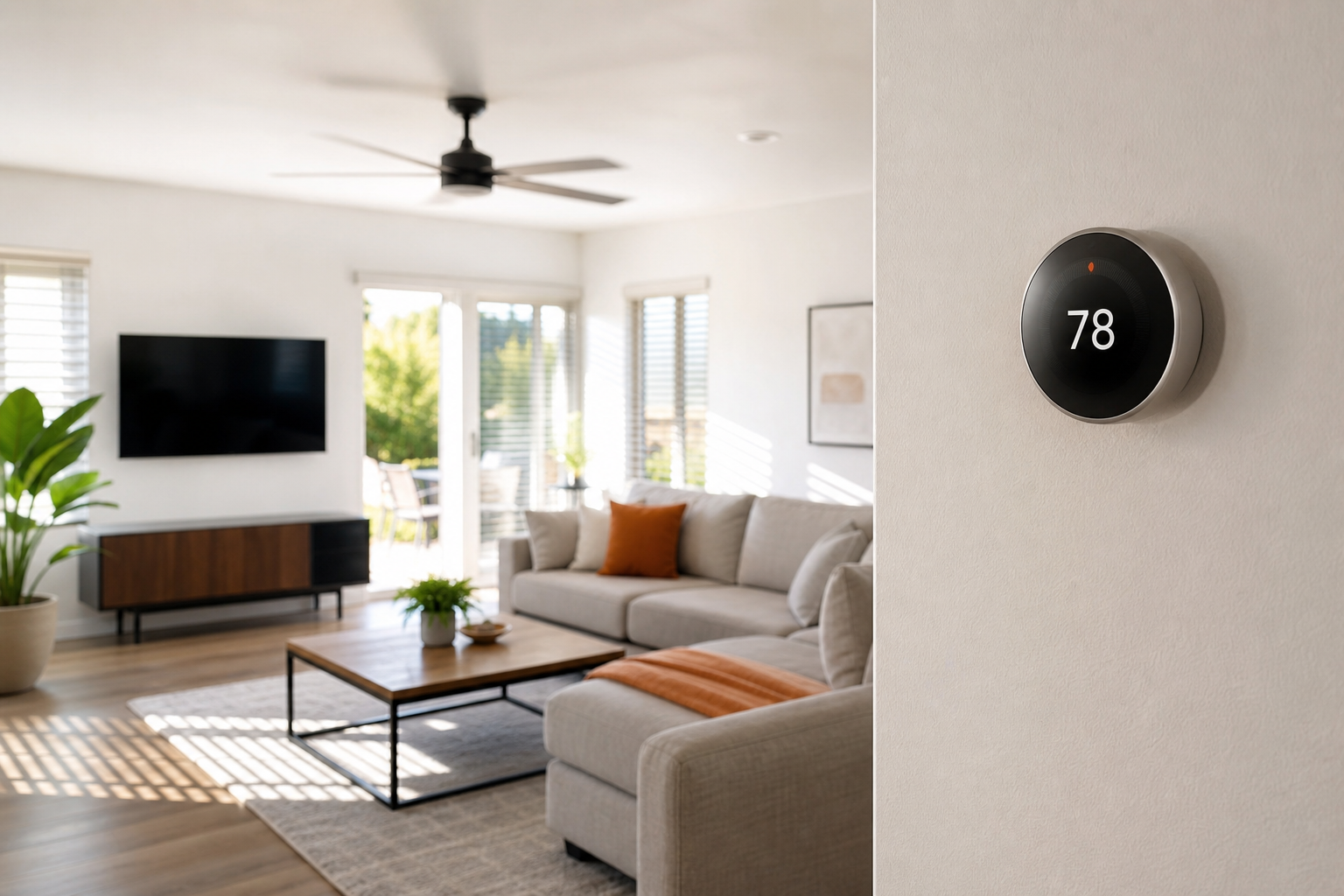
The data on savings is clearer than most people expect. Industry data shows a typical daytime occupied setting of around 78°F, with energy savings ranging from about 6% to 14% depending on how far above 72°F you set the thermostat.
Here's how the range breaks down in practice:
78°F while home and awake, the standard recommendation; comfortable for most adults with a ceiling fan
80, 82°F at night, pairs well with a ceiling fan set to spin counterclockwise, which pushes air down and creates a wind-chill effect that can make the room feel up to four degrees cooler
85°F when away for 4+ hours, the highest safe vacancy setting; keeps humidity in check while cutting costs by roughly 10%
Ceiling fans change the equation significantly. According to EPA data , raising your thermostat two degrees and adding a ceiling fan can deliver up to 14% in cooling savings. The fan doesn't actually lower the air temperature. It cools you through air movement, so turn it off when you leave the room.
Surveys have shown that many households keep their thermostat in the low 70s during the day. That gap between the low 70s and 78°F is real, and bridging it slowly, one degree per day, gives your body time to adjust without shock.
The usable method: start at your current setting and move it up one degree every two days. Most people find they can comfortably settle two to three degrees higher than where they started, which translates to 6, 9% savings without feeling like they're suffering through summer.
Pro Tip:If 78°F feels too warm, check your ceiling fan direction first. A fan spinning counterclockwise in summer pushes cool air down and can make the room feel 3, 4°F cooler without touching the thermostat.
Home Worx Heating and Cooling's Recommended Settings for Northern California Homes
Northern California's Sierra foothills play by different rules than coastal California. In Colfax, Auburn, Grass Valley, and the surrounding Placer and Nevada County communities, summer days regularly push past 100°F. Dry heat dominates, but afternoon temperatures can spike fast, and homes without good shade or insulation absorb that heat quickly.
At Home Worx Heating and Cooling , we work with homeowners across this region every summer, and the standard 78°F recommendation holds well here, with a few local adjustments worth knowing.
Pre-cooling before peak heat
In the foothills, peak outdoor temperatures often hit between 2 p.m. and 6 p.m. Running your AC to pre-cool the house to 76°F by early afternoon, then letting it drift up to 78°F during peak hours, reduces how hard the system has to work when outdoor temps are highest. This is easier on the equipment and often cheaper than fighting peak heat reactively.
The vacancy setting matters more here
Because our summers are dry rather than humid, raising the thermostat to 85°F while the house is empty is generally safe for most homes in Placer and Nevada Counties. Humidity-related mold risk, which is the main concern with high vacancy settings, is much lower in a dry climate than in coastal or southeastern states. That said, if your home has a crawl space or basement with moisture issues, keep the vacancy setting at 82°F to be cautious.
Smart thermostats pay off faster here
A programmable or smart thermostat lets you automate the 78°F/85°F/82°F schedule without thinking about it. For homeowners in Rocklin, Lincoln, Penn Valley, and similar communities where daily schedules are predictable, a smart thermostat typically pays for itself within one to two cooling seasons. If you're weighing the cost, our guide to smart thermostat installation costs breaks down what to expect.
Home Worx Heating and Cooling offers financing at around $4 a day, which makes it easier to install a new programmable thermostat or schedule a system tune-up before the heat peaks. We back every job with a satisfaction guarantee, and our 24/7 service means you're not stuck sweating through a breakdown on a 105°F afternoon.
How Local Climate, Sun Exposure, and Insulation Affect Your Thermostat Choice
Your thermostat setting is only as effective as the house behind it. Two homes set to 78°F can feel completely different if one has good attic insulation and the other doesn't. This is especially true in the Sierra foothills, where summer attic temperatures can exceed 130°F on hot days.
Attic insulation is the biggest factor
Heat moves from your attic into your living space constantly during summer. Without adequate insulation, your AC runs longer cycles just to maintain the set temperature. The result is higher bills and more wear on the system. Blown-in fiberglass or cellulose in the attic, combined with proper air sealing around penetrations, is the single most effective way to reduce that heat load.
Sun exposure changes everything
A west-facing room with large windows absorbs heat all afternoon. That room may feel 5, 8°F warmer than the rest of the house even when the AC is running. Closing blinds or curtains during peak sun hours, before 2 p.m. in the foothills, reduces solar gain significantly. Some homeowners add exterior shading or low-emissivity window film, which cuts heat transmission without blocking light entirely.
Air sealing matters as much as insulation
Gaps around recessed lights, attic hatches, and duct connections let conditioned air escape and hot air in. Your AC compensates by running longer, which drives up costs and shortens equipment life. Sealing those gaps is often inexpensive relative to the savings it delivers.
For homes in Colfax and Auburn where summer temperatures regularly push past 100°F, these building-envelope factors directly affect how hard your AC works and how long components last. Capacitors, for example, wear out faster in extreme heat. Understanding AC capacitor replacement costs is useful context if your system is more than eight years old and running in a hot climate.
The short version: if your home is well-insulated and air-sealed, you can hold 78°F comfortably with shorter AC cycles. If it isn't, you may find yourself lowering the thermostat just to feel comfortable, which costs more and doesn't fix the underlying problem.
Adjusting Settings for Different Situations: Nighttime, Home Office, and When You're Away
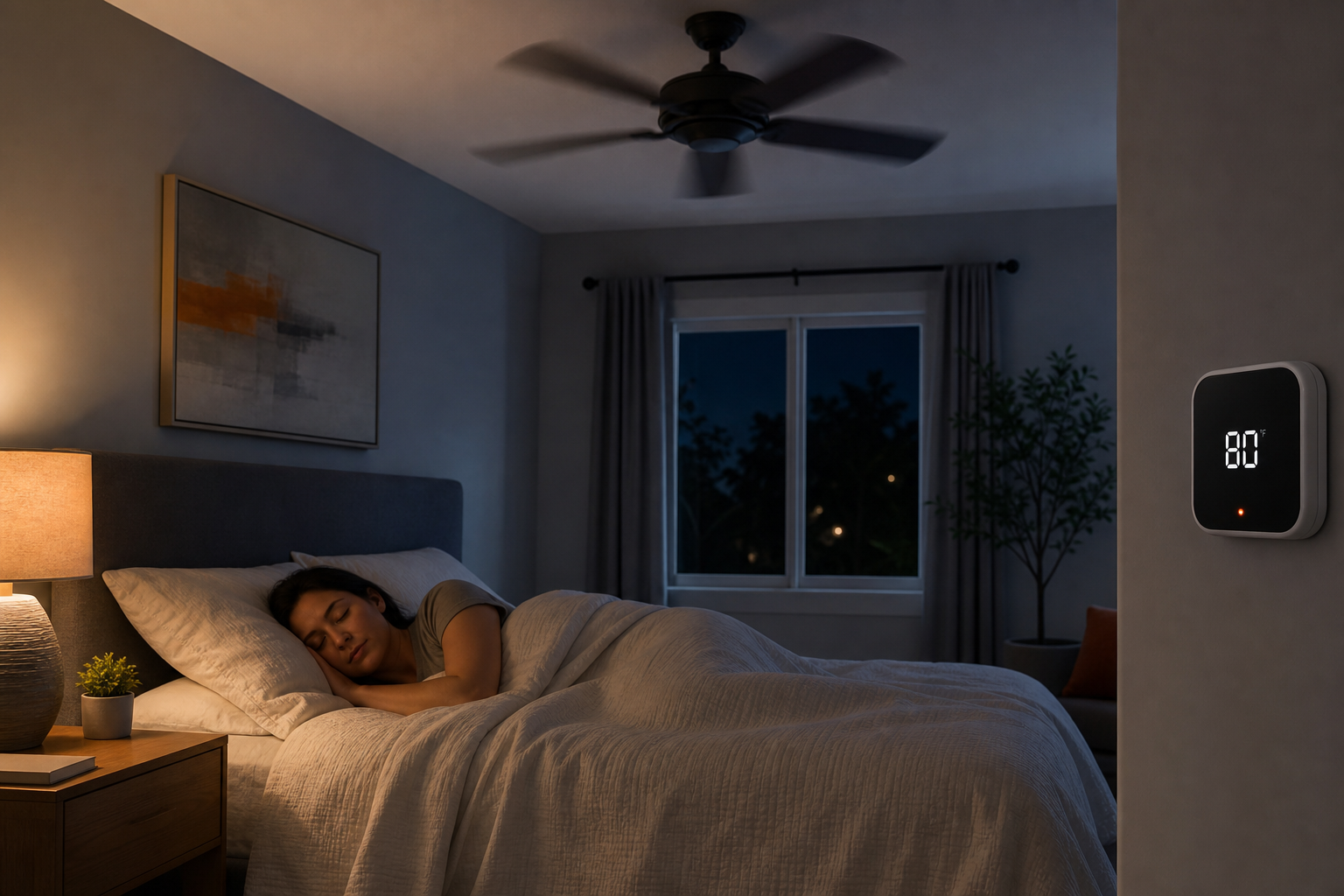
The 78°F baseline works well for general daytime living, but most households have at least two other scenarios that need different settings: sleeping and being away. Getting these right adds meaningful savings without any real sacrifice in comfort.
Nighttime: 80, 82°F with a fan
Your body temperature naturally drops during sleep, which means you need less cooling than you might expect. Most sleep research points to the mid-60s to low 70s as ideal for sleep quality, but that range is expensive to maintain all night. A usable compromise is 80°F with a ceiling fan running. The moving air makes it feel closer to 76°F, and most people sleep well at that effective temperature without the high cost of cooling to 68°F all night.
If someone in your household is heat-sensitive, try 78°F at bedtime and let it drift to 80°F after midnight when outdoor temperatures drop. A programmable thermostat handles this automatically.
Home office: 74, 76°F during work hours
If you work from home, you're likely more sedentary than someone moving around the house. Sitting still makes you feel the heat more. A setting of 74, 76°F during work hours is reasonable, especially if your office gets afternoon sun. Close the blinds, run a small desk fan, and your AC won't have to work nearly as hard to keep you focused.
Away for 4+ hours: 85°F maximum
When the house is empty, there's no reason to cool it to comfort levels. Raise the thermostat to 85°F. Three independent sources, including Trane and EcoFlow, cite this as the right ceiling for vacancy mode, primarily because you still want the system to run occasionally. Running occasionally keeps humidity from building up, which matters for wood furniture, electronics, and preventing mold.
Don't go above 85°F even in dry climates. At higher settings, the house takes much longer to recover when you return, which means the AC runs hard for an extended period and may end up using more energy than a steady 82°F would have.
A smart thermostat with geofencing automates all of this. It detects when your phone leaves the house and adjusts the setting. When you're heading home, it starts cooling down so the house is comfortable when you walk in. It's the lowest-effort way to capture the full savings from vacancy-mode settings.
Key Takeaway:Match your thermostat to what's actually happening in the house. Sleeping and vacancy settings can each save 10% or more compared to holding a single flat temperature all day.
Frequently Asked Questions
What temperature should I set my AC to in summer to save money?
Set it to 78°F when you're home and awake. Raise it to 85°F when you leave for more than four hours, and drop it to 80, 82°F at night. This three-setting approach follows DOE and ENERGY STAR guidance and can reduce cooling costs by 6, 14% compared to holding a flat 72, 73°F all day. Adding a ceiling fan lets you raise the thermostat another 2, 3 degrees without losing comfort.
Is 78°F really comfortable, or will I just be hot?
It depends on humidity and air movement. In dry climates like Placer and Nevada Counties, 78°F with a ceiling fan running feels noticeably cooler than 78°F in a still, humid room. If 78°F feels too warm at first, raise your current setting by one degree every couple of days to let your body adjust. Most people find they adapt within a week or two.
What temperature should I set my AC when I'm away from home?
85°F is the recommended maximum for vacancy mode. This keeps the system running just enough to control humidity while cutting cooling costs by roughly 10%. Don't go higher than 85°F, even in dry climates, because recovery time when you return becomes long enough to offset the savings. A programmable thermostat makes this automatic so you don't have to remember.
Does the outside temperature affect what I should set my thermostat to?
Yes, indirectly. Your AC works harder when outdoor temperatures are high, so the efficiency of any given thermostat setting drops on the hottest days. In the Sierra foothills, where temperatures regularly exceed 100°F, pre-cooling your home to 76°F before peak afternoon heat arrives reduces strain on the system during the hours when it has to work hardest. Good insulation and shaded windows reduce how much the outdoor temperature affects indoor comfort.
How much does raising the thermostat one degree actually save?
About 3% on your cooling bill per degree above 72°F, according to DOE data. That means going from 72°F to 78°F saves roughly 18% on the cooling portion of your bill. The savings compound when you also raise the setting during sleep and vacancy hours. Over a full summer in a hot climate like Placer County, those adjustments can add up to a meaningful reduction in your PG&E bill.
Can setting my AC too high damage my system?
Setting it above 85°F during vacancy periods can cause humidity to build up indoors, which stresses wood materials and can encourage mold growth. It also means the system barely runs, losing its humidity-removal function. When you return and demand rapid cooling, the system runs hard for a long stretch, which adds wear. Keep vacancy settings at 85°F or below, and schedule annual maintenance to catch any wear before it becomes a repair.
Conclusion
The right summer AC setting isn't complicated: 78°F when you're home, 85°F when you're away, and 80, 82°F overnight. Those three numbers are where comfort and efficiency meet, and a smart or programmable thermostat makes the whole thing automatic. If your system is struggling to hold those temperatures, or if your home heats up faster than it should, the issue is often insulation, air sealing, or an aging unit rather than the thermostat itself. The team at Home Worx Heating and Cooling serves homeowners across Placer and Nevada Counties, from Auburn and Colfax to Grass Valley and Penn Valley. Reach out to schedule a tune-up or talk through an upgrade before the next heat wave hits.